



Is the Thunder about to collapse? A detailed analysis of four main reasons for their rise and fall: losing free throw advantage and unstable three-point shooting



On January 7th Beijing time, the Thunder began with an impressive 24-1 record, dreaming of matching the Warriors' legendary 73-win season, but afterward, they only achieved a 6-6 record, losing their luster and coming back down to earth.
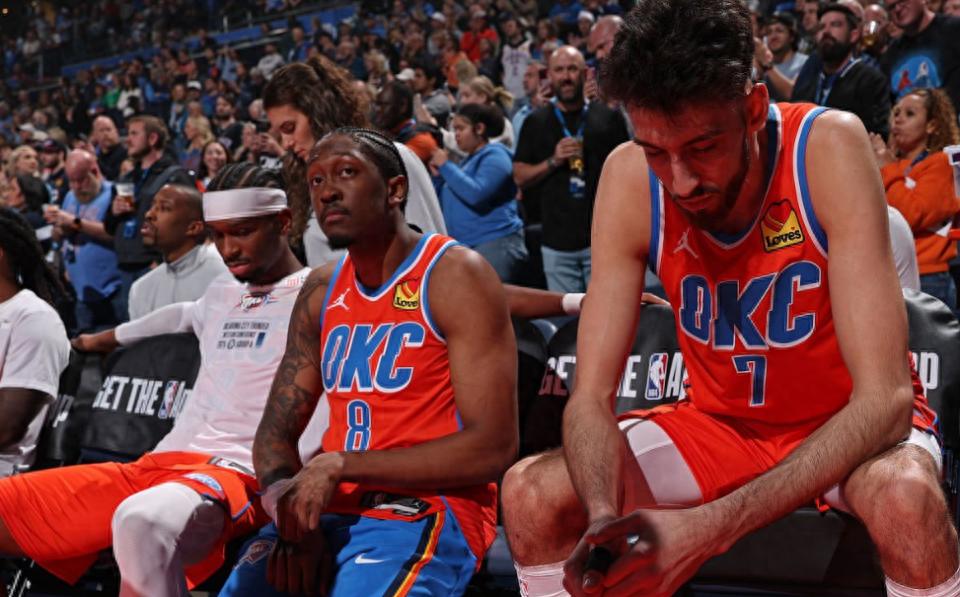
Right now, it’s worthwhile to revisit what Thunder GM Presti said in his April 2023 season wrap-up interview: “Every team in the league faces at least two moments each year when it feels like the sky is falling. Over 82 regular season games, no team can perform perfectly every game; you might have several weeks or even a month of terrible play. Of course, no one wants to endure months of slumps, but this season, every team still competing has gone through such dark times, and everyone panics because of it.”
Currently, the Thunder sit atop the Western Conference with a 30-7 record, leading the second-place Spurs by 4.5 games and the Eastern Conference-leading Pistons by 2.5 games, remaining the top favorite for the championship.
But now, it seems like the sky is really falling over Oklahoma City, and everyone is anxious. The well-known US media CBS has deeply analyzed the Thunder’s recent slump, listing the possible weaknesses that could block their path to defending the title—
1. Changes in referees’ foul calls have erased the free throw advantage
This is the primary reason. Free throws have always been the most controversial topic surrounding the Thunder, so let’s start here.
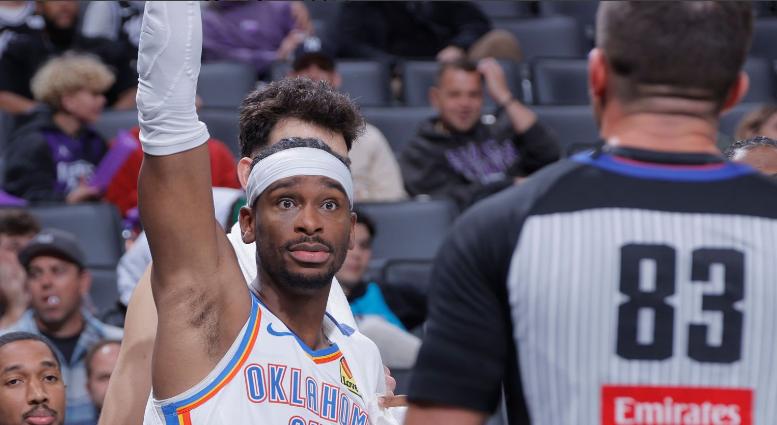
For a long time, not only fans but also opposing coaches and players have repeatedly complained about the double standard in defensive fouls called on the Thunder, especially on Shai Alexander, compared to how other teams defend them.
Timberwolves head coach Finch has been the most vocal critic, bluntly stating in February last year—
“Playing against this team is so frustrating; they foul constantly, really, fouling all the time. But you can’t even touch Shai without a call, which is maddening. To withstand that pressure and finish the game requires tremendous mental toughness.”
Not long ago, on December 20th, during the Timberwolves’ win over the Thunder, Finch lost his temper within minutes due to repeated missed calls by referees and was eventually ejected. He nearly stormed the court multiple times and was fined $35,000 afterward for his extreme reaction.
Did Finch’s outburst and the subsequent media attention influence the referees’ foul-calling standards? Possibly. Undoubtedly, the officiating treatment the Thunder have received recently is very different from early in the season, and data clearly supports this.
Here are the Thunder’s team free throw statistics (league rankings in parentheses)—
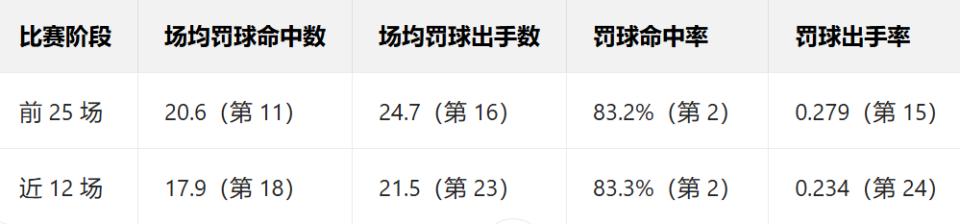
During this slump, the Thunder’s average free throw points per game dropped by nearly 3 points. Notably, Shai Alexander, the only player on the team averaging more than 3.8 free throw attempts per game, accounts for almost the entire drop in this statistic.
Here are Alexander’s individual free throw stats (league rankings in parentheses)—
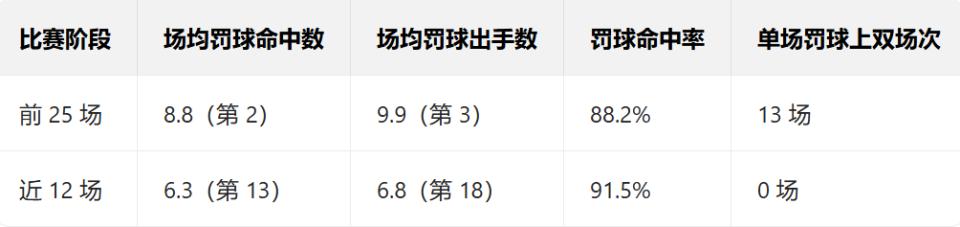
It’s important to highlight that during the team’s slump, Alexander’s average drives per game actually increased: in the first 25 games, he averaged 17.5 drives (4th in the league), and in the recent 12 games, 18.8 drives (3rd in the league). Nevertheless, his free throw attempts have sharply declined.
If this trend continues, opponents will be able to easily prevent Alexander from getting to the free throw line, which would severely damage the Thunder’s offensive system.
2. Role players’ inconsistent form leads to excessive reliance on the core
This season, the Thunder have scored a total of 4,486 points, with Alexander personally contributing 1,191 points and assisting teammates in scoring 591 points, totaling 1,782 points, which is 39.7% of the team’s total scoring. He leads the team by a wide margin in average points per game (31.6), assists per game (6.4), and minutes per game (33.1). Although the Thunder’s roster depth has always been praised, their role players’ inconsistent offensive performance means the team still heavily depends on Alexander’s individual output.
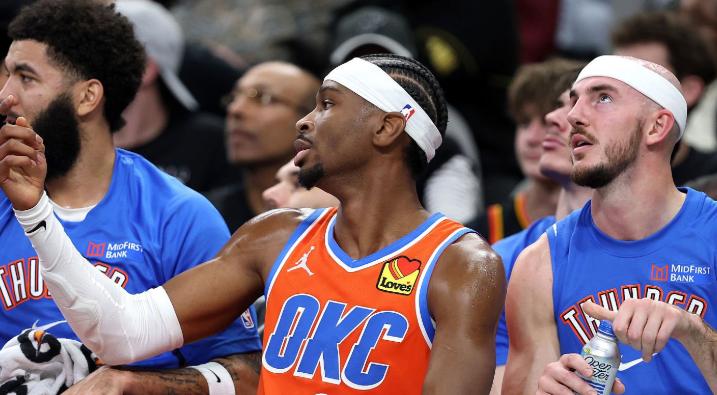
When Alexander is on the court for 1,191 minutes, the Thunder’s offensive rating is an impressive 122.1; however, in the 605 minutes he is off the court, the team’s offensive rating plummets to 108.8.
This season, aside from Alexander, no other Thunder player averages 20 or more points per game. Except for Jalen Williams—who has yet to regain peak form after offseason wrist surgery—other role players lack the ability to create offense independently. Without Alexander’s leadership, the Thunder struggle to generate effective scoring opportunities in half-court sets.
However, good news for the Thunder is Alexander’s historically consistent performance in recent years: since October 30, 2024, he has scored at least 20 points in 108 consecutive games, the second-longest streak in NBA history; since his first All-NBA First Team selection in 2022-23, he has only failed to reach 20 points in 10 games.
Since the Thunder entered title contention in the 2023-24 season, Alexander has scored 30+ points in 126 of 187 games played, with the team’s record being 104-22 in those games. He missed only 14 games during this period and has mostly carried the team forward.
But when his performance dips, the Thunder’s competitiveness suffers greatly, as recent games show. In Tuesday’s loss to the Hornets, Alexander shot 7-for-21 and scored just 21 points, marking his worst offensive game this season. In fact, his three worst games this season have all occurred in the past two weeks—
December 26 loss to the Spurs: 22 points, 6 rebounds, 4 assists, 7-for-19 shooting, 1-for-6 from three
January 5 loss to the Suns: 25 points, 0 rebounds, 6 assists, 8-for-22 shooting, 1-for-5 from three
January 6 loss to the Hornets: 21 points, 2 rebounds, 6 assists, 7-for-21 shooting, 1-for-5 from three
Although in the recent 12 games Alexander still averages 29.5 points on 52.2% shooting, when he needs support, his teammates have not stepped up. Except for Dort and Caruso, all other rotation players have averaged fewer points in these 12 games than during the team’s 24-1 hot start.
Here are the changes in average points scored by role players—
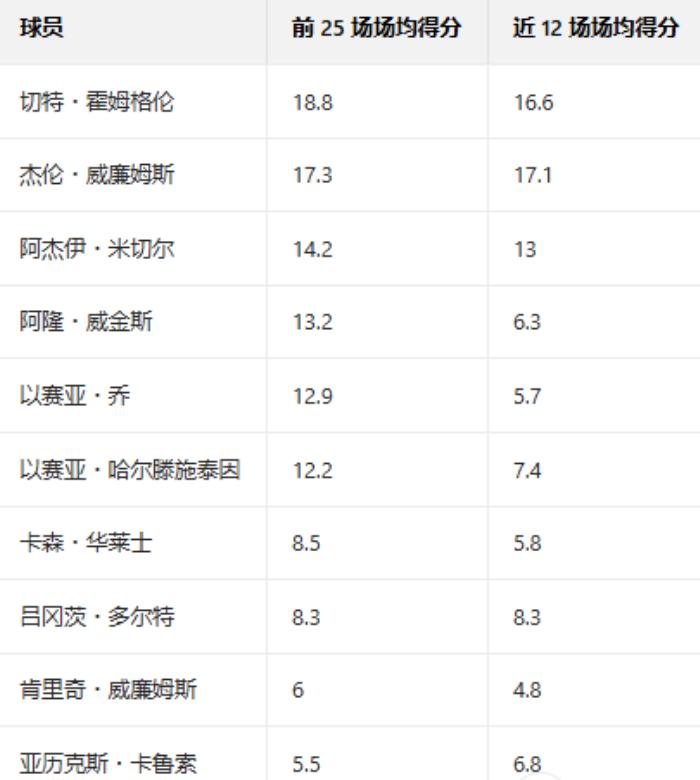
Of course, playing time, role assignments, and injuries contribute to some players’ statistical declines, but this data chart clearly reflects the current situation. Notably, the combined average points by Holmgren and Jalen Williams dropped from 36.1 to 33.7; the number of players besides Alexander averaging double-digit points fell from six to three.
It is reasonable to suspect that carrying such a heavy offensive load nearly every game has caused some fatigue for Alexander. Recent performances confirm that if Alexander cannot maintain his dominant level, the Thunder will struggle to be a top-tier team in the league.
3. Fluctuating three-point shooting leads to inconsistent outside scoring
Throughout their rise, the Thunder have never been a team known for heavy three-point shooting. Besides Isaiah Joe, they have lacked true elite shooters—Joe himself often hovers on the edge of the rotation. Overall, the shooters around Alexander pose some threat but are prone to long cold streaks.
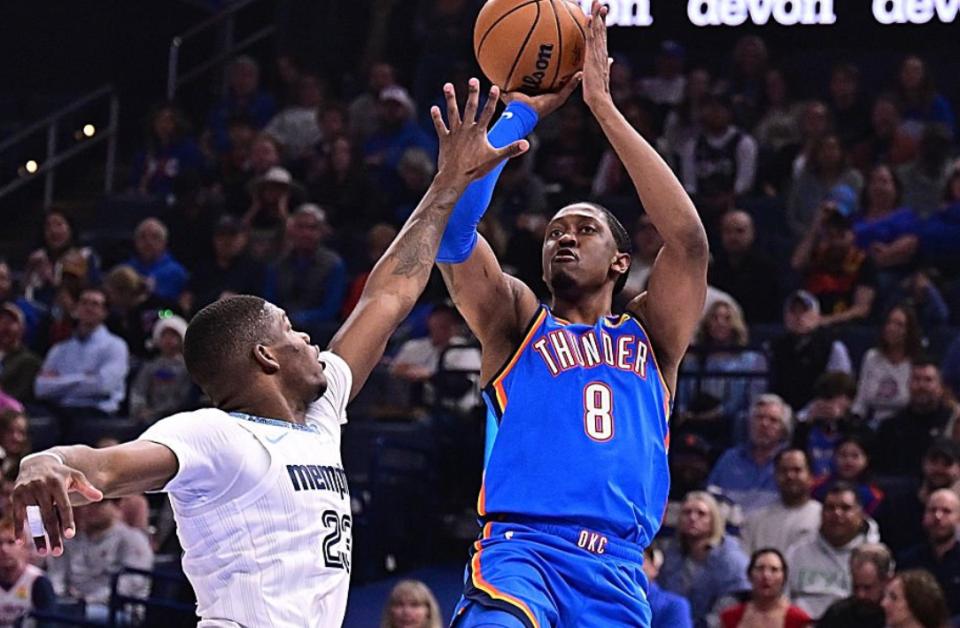
In the 2024 playoffs second round, the Thunder’s upset loss to the Mavericks was largely due to their 33.5% three-point shooting in that series. Even during last season’s championship run, they faced multiple playoff stretches of poor three-point shooting: against the Grizzlies, their three-point percentage was only 31.3%, but their overall strength overcame this weakness; however, in the second round versus the Nuggets, their three-point shooting was just 32.3%, barely winning the series in seven games.
The recent 12-game slump again confirms the Thunder’s unstable outside shooting.
Here are the Thunder’s team three-point shooting stats (league rankings in parentheses)—
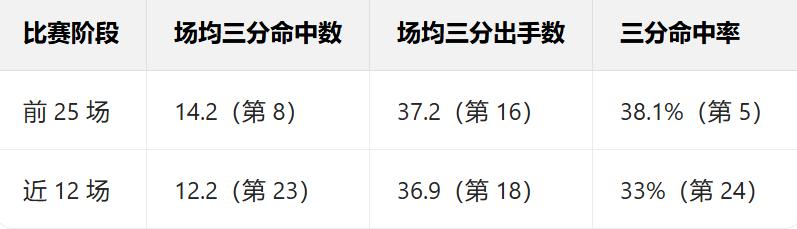
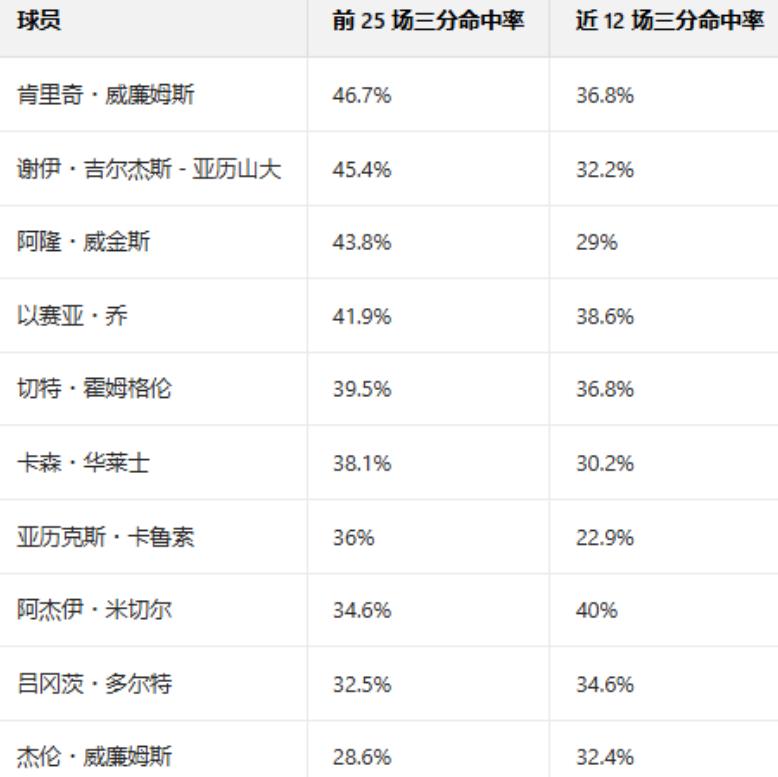
Alexander’s three-point shooting has plummeted, despite ranking third on the team in attempts per game this season (4.9). This issue is particularly glaring. Moreover, the entire team’s three-point shooting has declined to varying degrees.
Kenrich Williams, Wiggins, Wallace, and Caruso have all seen their three-point percentages drop by at least 8 percentage points since early in the season. Although Dort’s recent three-point shooting has somewhat improved, he has yet to replicate last season’s form when he set a career-high 41.2% three-point accuracy.
Here are the changes in players’ three-point shooting percentages—
However, the good news for the Thunder is they still generate many open three-point opportunities. In the last 12 games, they have averaged 24 open three-point attempts per game, ranking third in the league, but their open three-point shooting percentage is only 34.4%, placing them 28th. As long as they keep creating these open looks, their shooting percentage should eventually rebound.
But recent evidence shows that without acquiring better shooters, the Thunder’s three-point shooting will continue to be erratic. Will Presti make moves before the trade deadline to strengthen the team’s outside shooting space?
4. Increasing schedule difficulty and condensed games test endurance
The tougher schedule is another key factor in the Thunder’s recent decline.
During their 24-1 dream start, they faced only five teams with winning percentages above 50%. In the recent 6-6 slump, they have played six teams with winning percentages over 50%, losing four of those games. So far this season, the Thunder’s record against teams below .500 is 24-2, while against teams above .500, it is only 6-5. Notably, three of those five losses came against the second-place Spurs in the West.
Additionally, after the NBA Cup, the Thunder played 11 games in 19 days. The loss to the Hornets was their second game in back-to-back matchups and their third game in four days following a West Coast road trip.More dauntingly, the Thunder’s remaining schedule is the toughest in the league, with opponents averaging a 54.5% winning percentage.
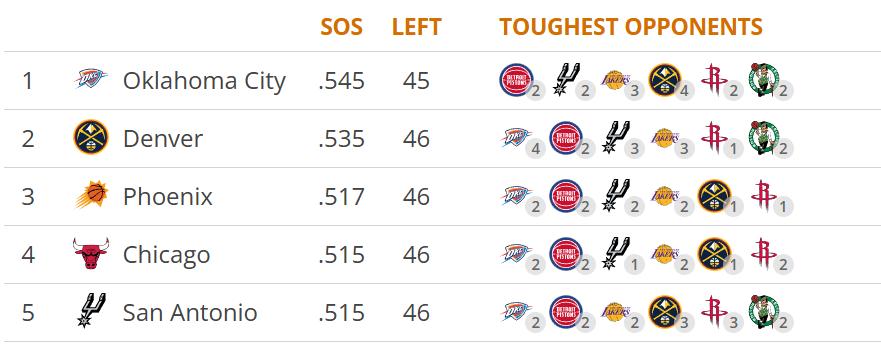
The Thunder remain the clear favorites for the championship and still have a chance to finish the regular season with the best record in the league. However, their path to defending the title no longer looks as certain as it did a month ago.


Wonderfulshortvideo
Coop makes history 😱


Steph & LaMelo shot the lights out 🤩
What a
Luka & LeBron led the @Lakers to a win, combining for 73-pts on the night 🤩
🏆 Clarkson coming in CLUTCH 🏆
Short… SIKE
LaMelo Ball had an amazing game tonight 💫
 Links
Links
 Contact
Address:UNIT 1804 SOUTH BANK TOWER, 55 UPPER GROUND,LONDON ENGLAND SE1 9E
Number:+85259695367
E-mali:[email protected]
 App
App


