



Assessment and Foundation: Shao Jiayi’s New Chinese National Football Team Begins Rebuilding from “Understanding Tactics”



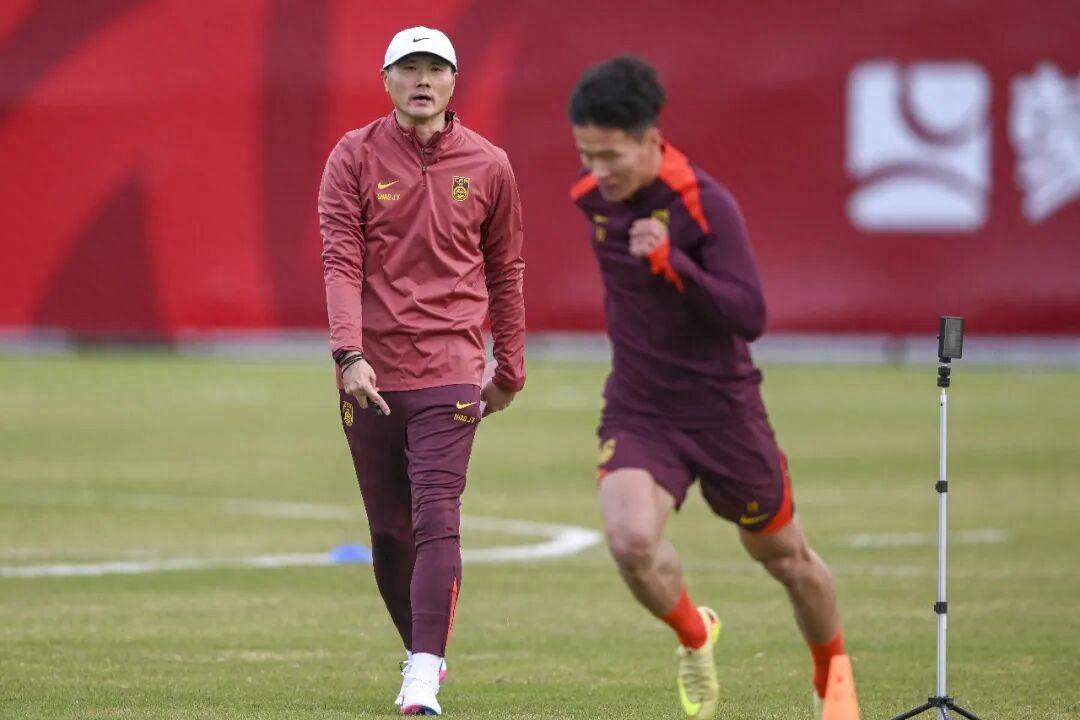
Reporter Chen Yong reports On January 4th, the “Shao Jiayi era” national team officially began training in Zhaoqing, Guangdong, and will continue training in the UAE. Because the majority of young players are with the U23 national team, Shao Jiayi’s initial training camp has a selection team nature, emphasizing the dissemination and rehearsal of his coaching ideas.

On January 4th, the new national team coach Shao Jiayi held a media conference in Zhaoqing, Guangdong, where he said: “As a player and coach nurtured by the country, I grew up playing football supported by national subsidies, so our generation of footballers is full of gratitude to the country. As a player, representing the country at the World Cup is our ultimate dream, and as a coach, it is the same. I believe every national team coach in the world dreams of competing in the World Cup.”
During the press conference and subsequent interviews, Shao Jiayi clearly explained his tactical philosophy, which can be summarized as holistic football, quick transitions, solid counterattacks, and valuing every training session and match.
First, the holistic approach means that whether attacking or defending, or transitioning quickly, everyone must participate to maximize team benefits. Currently, China ranks just after the top 10 in Asia, and most matches in the Asian zone pit weaker teams against stronger ones, so the holistic football philosophy is naturally crucial.
Second, the emphasis on speed focuses not only on individual pace but more on the overall speed of transitions, which is a key point Shao Jiayi stresses at this stage. For the national team, full-court rapid transitions are difficult to achieve, but based on solid defense, quick defensive-to-offensive transitions are the target; naturally, offensive-to-defensive transitions are equally important.
Third, tactically, there will be a greater focus on pragmatism and solid defense. He stated: “We need to be pragmatic. At this stage, through the team’s efforts, we want to first consolidate our defense, and on that basis pursue more efficient offense. This is the style of football I hope the national team can play in the future.” Given the current strength of the team, this is a practical choice.
Finally, Shao Jiayi emphasized that all national players must highly value every training session and give their all in every friendly match: “I believe every national team match is a do-or-die battle, each game relates to fans’ expectations and the team’s future direction, so there is no room for negligence or slackness. Over the next year, preparation will follow FIFA’s calendar and timing, with Asian Cup preparations at the end of the year and training camps at the start. We will cherish every training opportunity and build a solid foundation.” This directly addresses the previous chronic problem of the team treating friendlies carelessly and failing to perform fully in official matches.
Based on these principles, the national team’s physical conditioning and morale become key priorities, as mental state and fitness are critical to enforcing tactical discipline.

Because main players born in 2003 and later are competing in the U23 Asian Cup, this training roster does not include young players. However, looking ahead, no less than one-third of future national team training players will be born in 2003 or later, including established national team members like Wang Yudong and Hu Hetao, as well as more young talents. Thus, a major task of this training camp is player evaluation and selection. Of the current 26 players, around 15 are likely to remain stable members of the national team.
In fact, during the U23 Asian Cup opening match against Iraq, national players Wang Yudong and Hu Hetao performed excellently. Goalkeeper Li Hao, right-back Yang Xi, and defensive midfielder Xu Bin also stood out; these three players were part of Shao Jiayi’s Qingdao West Coast squad. Additionally, the U23 team’s defensive line showed very strong performance.
Shao Jiayi noted that many U23 players meet the national team’s requirements, but selection standards mainly depend on consistent and outstanding performances in league matches.
Although the squad is not yet complete, the national team’s training is not only about selection. Another main goal at this stage is to instill the coaching philosophy and solidify it through training. Shao Jiayi said: “Through these weeks of training, we want the players to understand the style of football the coach wants to implement and grasp the tactical ideas; this is extremely important.”
In other words, about two-thirds of the senior players need to first comprehend Shao Jiayi’s tactical approach. The success of implementing his tactics largely depends on these two-thirds of experienced players, since those born in 2003 and later either have followed Shao Jiayi in youth national teams or clubs, making them more familiar with his style and capable of strong execution. From this perspective, the ability to execute Shao Jiayi’s tactical philosophy is a core criterion for player selection.


Wonderfulshortvideo
The footwork, the finish 🤌


The Wirtz x Sané link-up 🔗
Which counterattack is
Griezmann with the cool finish 🥶
“afcon funny moments”
🤤🤤
When Diogo Costa made himself a hero 🧤
 Links
Links
 Contact
Address:UNIT 1804 SOUTH BANK TOWER, 55 UPPER GROUND,LONDON ENGLAND SE1 9E
Number:+85259695367
E-mali:[email protected]
 App
App


