



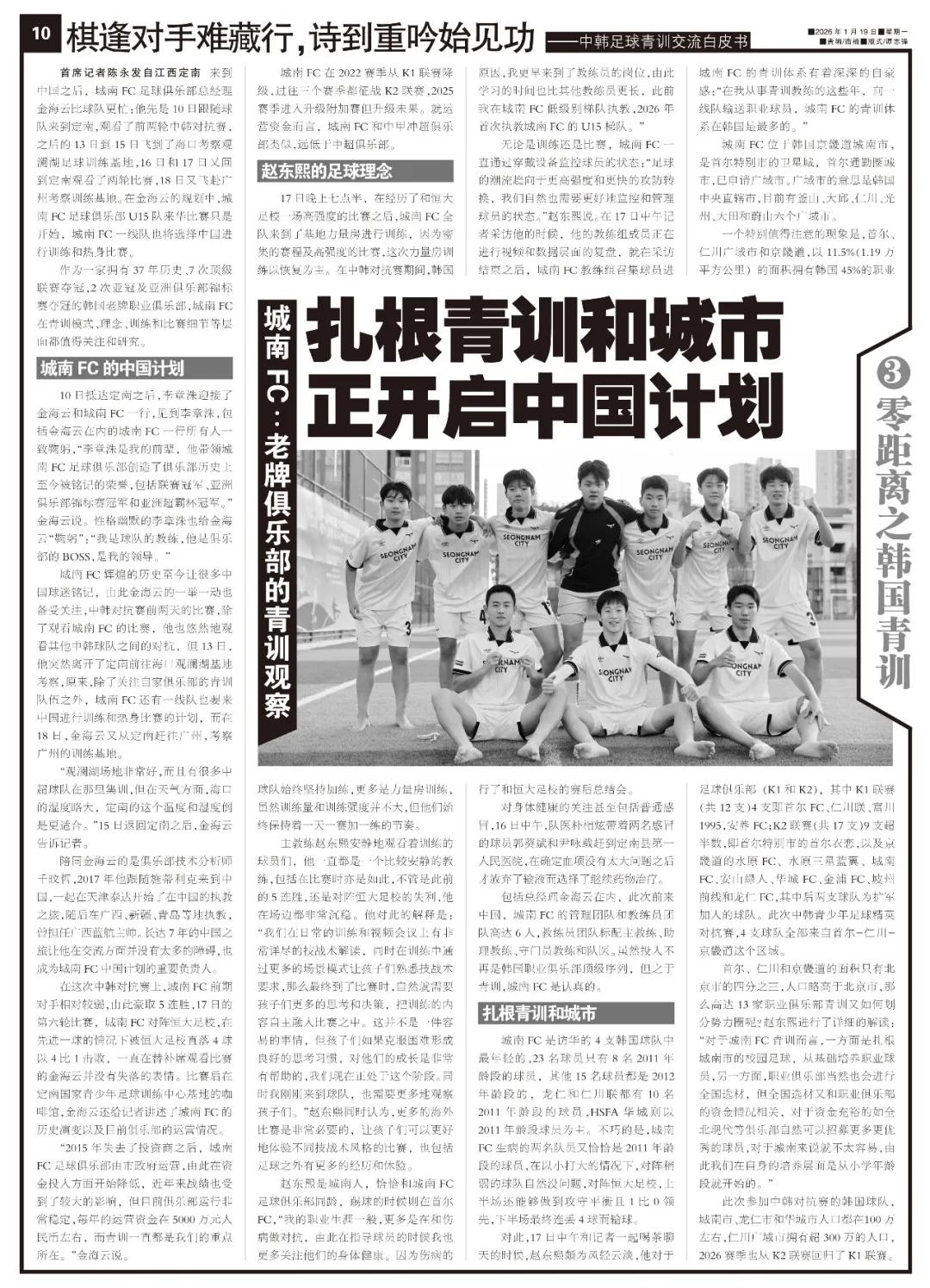
After the U15 team’s visit to China, the senior squad from Seongnam FC is also coming as the club launches its China initiative!


Reporter Chen Yong reporting from Dingnan, Jiangxi After arriving in China, Seongnam FC’s general manager Kim Haeyoon has been even busier than the team: first, on the 10th, he came to Dingnan with the team to watch the first two rounds of the China-Korea youth confrontation matches. Then from the 13th to 15th, he flew to Haikou to inspect the Mission Hills football training base. On the 16th and 17th, he returned to Dingnan to watch two more rounds of games, and on the 18th, he flew to Guangzhou to check out a training base there. According to Kim’s plan, the Seongnam FC U15 team’s visit to China is just the beginning; the senior Seongnam FC team will also choose China for training and friendly matches.
As a well-established Korean professional club with 37 years of history, seven top-league championships, two AFC Champions League titles, and two Asian Club Championship wins, Seongnam FC’s youth training model, philosophy, training methods, and match details are all worthy of attention and study.

Upon arriving in Dingnan on the 10th, Lee Jang-soo welcomed Kim Haeyoon and the Seongnam FC delegation. Upon meeting Lee, everyone in the group, including Kim, bowed in unison. “Lee Jang-soo is my predecessor; he led Seongnam FC to historic honors still remembered today, including league titles, the Asian Club Championship, and the Asian Super Cup,” Kim said. The humorous Lee Jang-soo also bowed back to Kim: “I’m the team’s coach, and he’s the club’s BOSS, my superior.”
Seongnam FC’s glorious history remains deeply etched in the memories of many Chinese fans, so Kim Haeyoon’s every move attracts attention. During the first two days of the China-Korea youth matches, besides watching Seongnam FC’s games, he also casually observed other China-Korea team confrontations. However, on the 13th, he suddenly left Dingnan to visit the Mission Hills base in Haikou. Besides focusing on his club’s youth team, Seongnam FC also plans to bring their senior team to China for training and warm-up matches. On the 18th, Kim rushed from Dingnan to Guangzhou to inspect training facilities there.
“The Mission Hills facilities are excellent, and many Chinese Super League teams train there, but regarding weather, Haikou’s humidity is a bit high. The temperature and humidity in Dingnan are actually more suitable,” Kim told reporters after returning to Dingnan on the 15th.
Accompanying Kim Haeyoon was the club’s technical analyst Chon Min-cheol, who came to China in 2017 with Stielike and began his coaching journey with Tianjin Teda. He later coached in Guangxi, Xinjiang, Qingdao, and served as head coach of Guangxi Blue Airlines. His seven-year experience in China has eased communication, making him a key figure in Seongnam FC’s China plans.
In this China-Korea youth confrontation, Seongnam FC initially faced relatively weaker opponents and achieved five consecutive wins. In the sixth round on the 17th, Seongnam FC played against Guangzhou Evergrande Football School. Despite taking an early lead, they were defeated 4-1 after conceding four consecutive goals. Kim Haeyoon, who watched the match from the bench, showed no signs of disappointment. After the match, at the Dingnan National Youth Football Training Center café, Kim shared with reporters the club’s historical development and current operations.
“After losing our investor in 2015, Seongnam FC was run by the city government, leading to reduced funding. This has significantly affected our recent results. However, the club’s operations are currently stable, with an annual budget of about 50 million RMB. Youth development has always been our focus,” Kim said. Seongnam FC was relegated from the K1 League in 2022 and has competed in the K2 League for the past three seasons. In 2025, they reached the promotion playoffs but failed to move up. In terms of funding, Seongnam FC is comparable to China League One promotion contenders but far below Chinese Super League clubs.
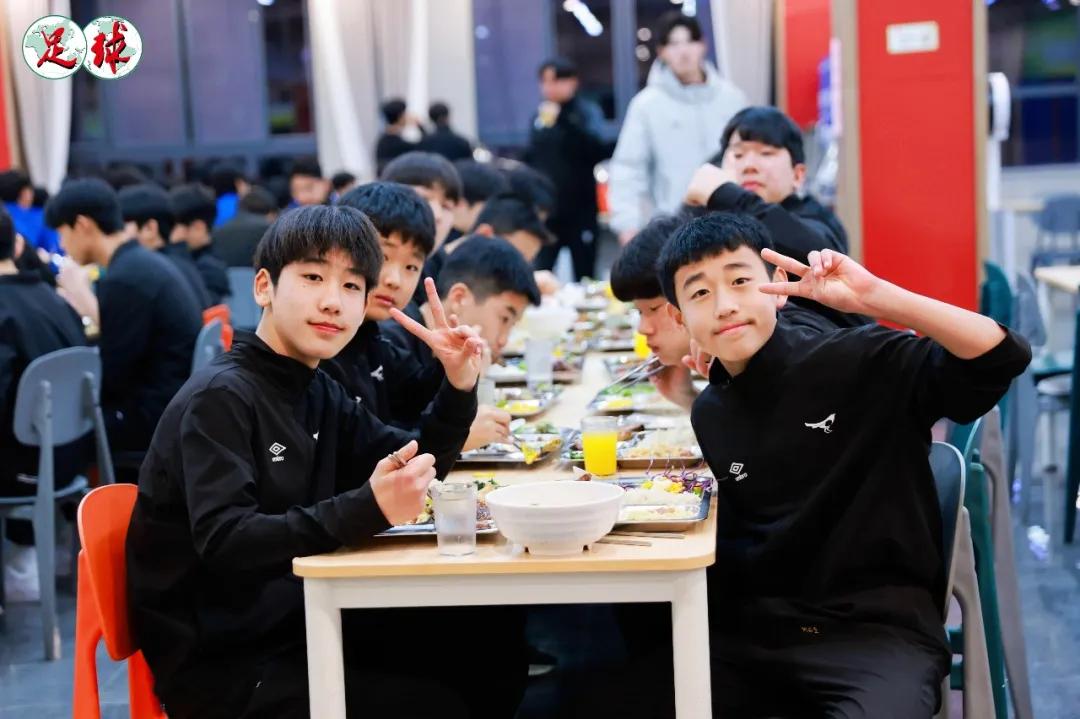

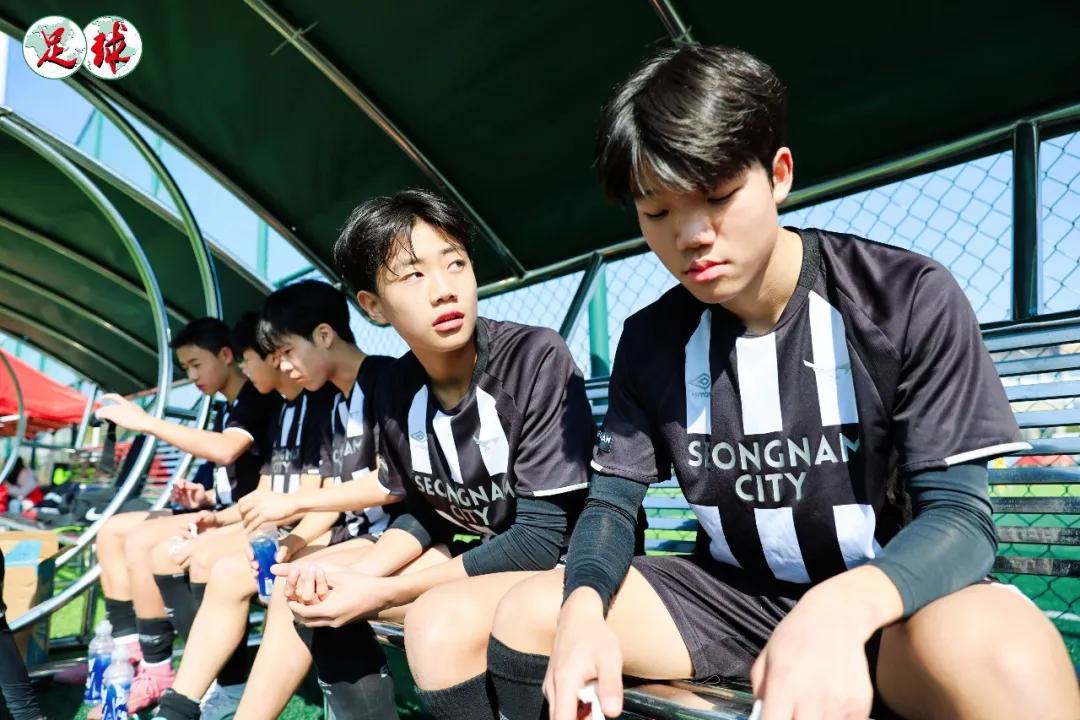
At 7:30 PM on the 17th, after a high-intensity match against Guangzhou Evergrande Football School, the entire Seongnam FC team went to the training center’s gym for recovery-focused strength training due to the dense schedule and match intensity. Throughout the China-Korea youth confrontation, Korean teams consistently added extra training sessions, mostly strength training, maintaining a rhythm of one match plus one training session daily, although the intensity was moderate.
Head coach Jo Dong-hee quietly observed the players during training. He has always been a calm coach, both during matches and training. Whether during the previous five consecutive wins or the loss to Guangzhou Evergrande Football School, he remained composed on the sidelines. He explained: “We conduct detailed tactical analysis in daily training and video meetings, and through varied scenarios in practice, we help the players familiarize themselves with tactical demands. Thus, during matches, players need to think and make decisions independently, integrating what they’ve learned into the game.”
“This is not an easy task, but if the players overcome these challenges and develop good thinking habits, it greatly benefits their growth. We are currently at that stage. Also, since I have just joined the team, I need more time to observe the players,” Jo said. He also believes that more overseas matches are essential, allowing players to experience different tactical styles and gain broader experiences beyond football.
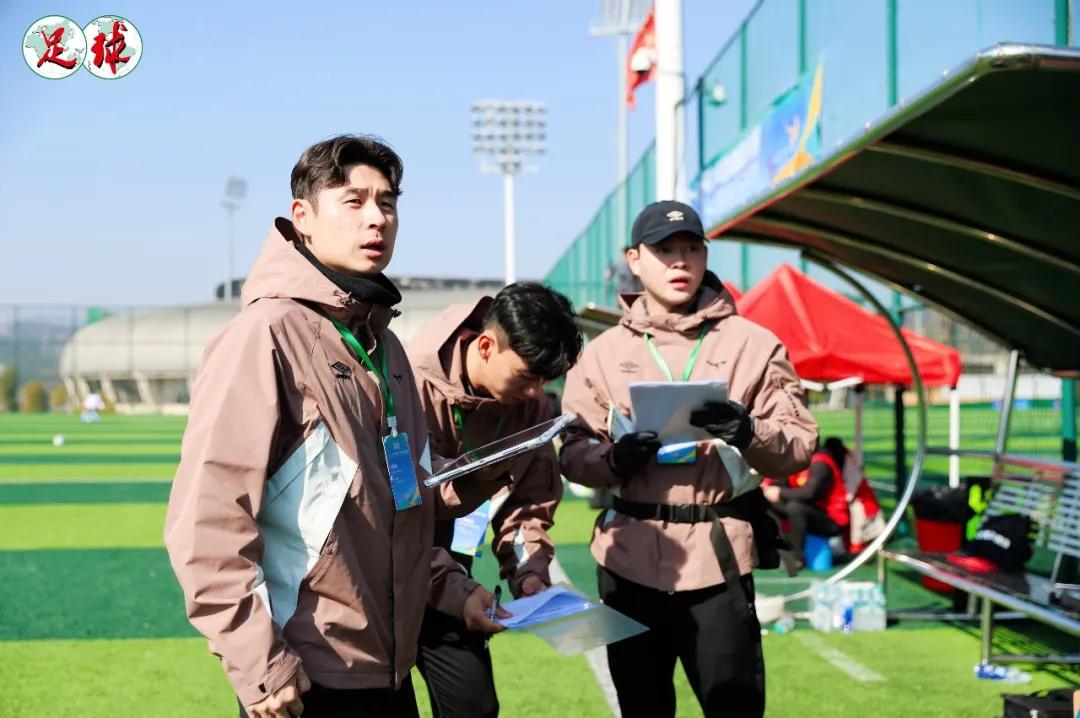
Jo Dong-hee is from Seongnam, coincidentally the same age as Seongnam FC. He played for Seoul FC during his career. “My playing career was average, mostly battling injuries, which made me focus more on players’ physical health when coaching. Due to injuries, I transitioned to coaching earlier than others, so I have spent more time learning. Previously, I coached lower-level teams at Seongnam FC, and 2026 marks my first year coaching the U15 squad.”
Whether in training or matches, Seongnam FC consistently uses wearable devices to monitor players’ conditions. “Football trends toward higher intensity and faster transitions between attack and defense, so naturally, we need to monitor and manage players’ conditions better,” Jo said. During a midday interview on the 17th, his coaching staff was reviewing videos and data. Right after the interview, the coaching team gathered players for a post-match review of the game against Guangzhou Evergrande Football School.
Attention to physical health extends even to common colds. At noon on the 16th, team doctor Park Sang-hyun took two players with colds, Guo Kuibin and Yin Yongzai, to Dingnan County First People’s Hospital. After confirming there were no serious blood issues, they abandoned intravenous treatment and opted to continue with medication.
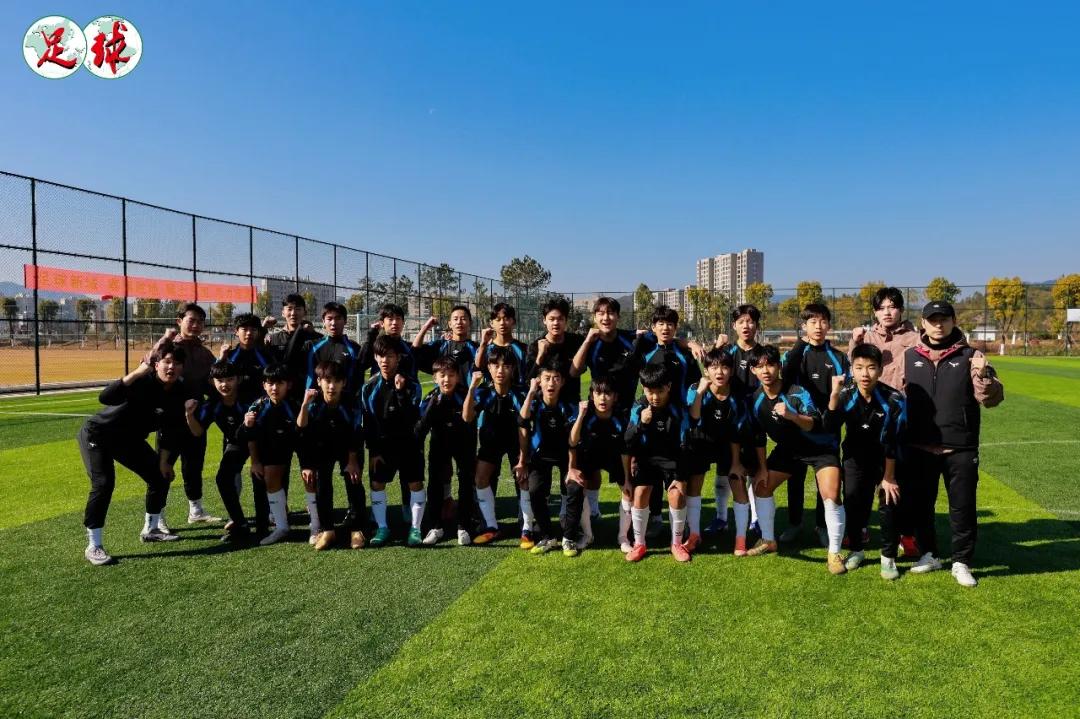
Including general manager Kim Haeyoon, Seongnam FC’s delegation to China includes six management and coaching staff members. The coaching team comprises a head coach, assistant coach, goalkeeper coach, and team doctor. Although their investment no longer ranks among Korea’s top professional clubs, Seongnam FC remains serious about youth training.
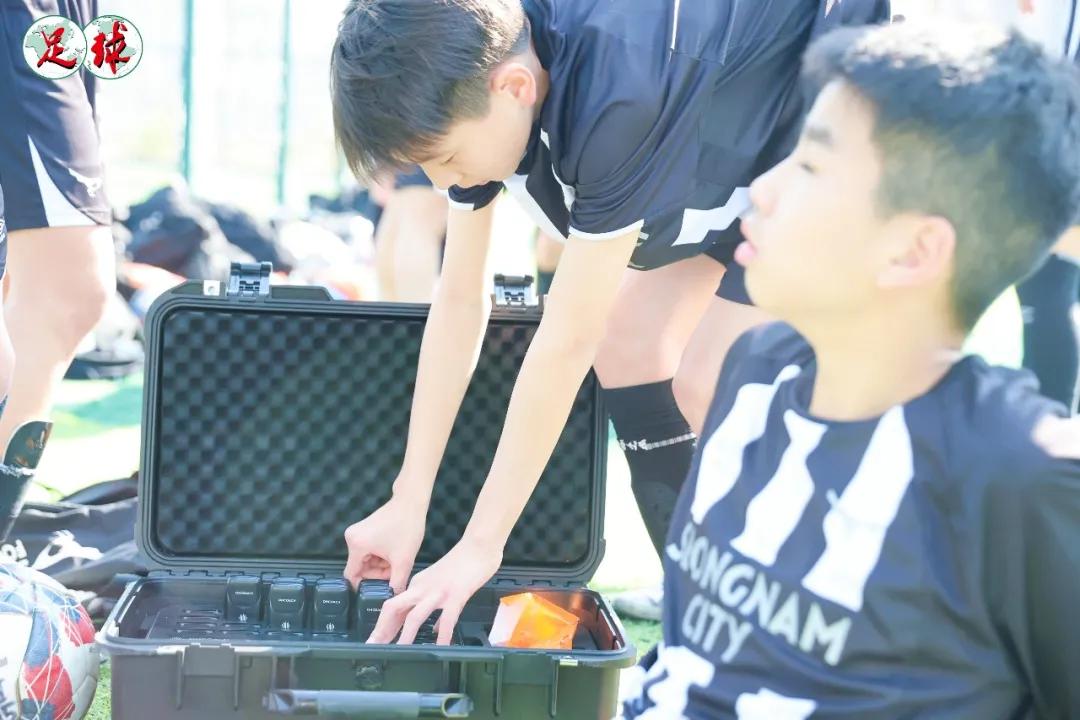

Seongnam FC is the youngest of the four Korean teams visiting China for this competition. Of the 23 players, only eight belong to the 2011 age group, while the other 15 are from the 2012 age group. In comparison, Yongin and Incheon United each have ten players from the 2011 age group, and HSFA Hwaseong mainly consists of 2011 players. Unfortunately, Seongnam FC’s two sick players are both from the 2011 group. While they had no trouble against weaker teams, against Guangzhou Evergrande Football School, they maintained balance and a 1-0 lead in the first half but conceded four goals in the second half to lose.
Regarding this, during a tea chat with reporters at noon on the 17th, Jo Dong-hee was quite calm and expressed deep pride in Seongnam FC’s youth training system: “In my years as a youth coach, Seongnam FC has produced the most professional players advancing to the senior team in Korea.”
Seongnam FC is located in Seongnam City, Gyeonggi Province, a satellite city of Seoul within the Seoul metropolitan commute zone, and has applied to become a metropolitan city. A metropolitan city in Korea is a centrally governed city; currently, there are six metropolitan cities: Busan, Daegu, Incheon, Gwangju, Daejeon, and Ulsan.

One notable phenomenon is that Seoul, Incheon metropolitan city, and Gyeonggi Province, covering 11.5% (11,900 square kilometers) of the land area, host 45% of Korea’s professional football clubs (K1 and K2). Among the 12 K1 League teams, four are from this region: Seoul FC, Incheon United, Bucheon 1995, and Anyang FC. Among the 17 K2 League teams, nine are from this area, including Seoul E-Land from Seoul Special City, and Suwon FC, Suwon Samsung Bluewings, Seongnam FC, Ansan Greeners, Hwaseong FC, Gimpo FC, Paju Forward, and Yongin FC from Gyeonggi Province. The last two teams joined via league expansion. All four Korean teams participating in the China-Korea youth elite confrontation come from the Seoul-Incheon-Gyeonggi area.
Seoul, Incheon, and Gyeonggi cover only about three-quarters of Beijing’s area, with a population slightly higher than Beijing’s. How do 13 professional clubs’ youth academies divide their spheres of influence? Jo Dong-hee explained in detail: “For Seongnam FC’s youth training, one part is rooted in Seongnam City’s school football, cultivating professional players from the grassroots. On the other hand, professional clubs do nationwide scouting, but this depends on club finances. Clubs with ample funds, like Jeonbuk Hyundai, can recruit more and better players, which is harder for Seongnam. Therefore, our own development starts from elementary school age.”
The Korean teams participating in the China-Korea confrontation come from cities with populations around one million each — Seongnam, Yongin, and Hwaseong — while Incheon metropolitan city has over three million residents. In the 2026 season, Incheon also returned to the K1 League from K2.


Wonderfulshortvideo
The footwork, the finish 🤌


Did you get it? 🤔😅
The Wirtz x Sané link-up 🔗
Haaland’s movement 🥵
Which counterattack is
Griezmann with the cool finish 🥶
“afcon funny moments”
 Links
Links
 Contact
Address:UNIT 1804 SOUTH BANK TOWER, 55 UPPER GROUND,LONDON ENGLAND SE1 9E
Number:+85259695367
E-mali:[email protected]
 App
App


