



TACTICAL ANALYSIS: The secrets to Arsenal winning the Champions League



Arsenal are targeting the perfect end to their season with a Champions League title when they take on PSG tonight. Yet Arteta and his squad are well aware that a very tough test awaits them.
The London club has performed exceptionally well in European competition thanks to a dominant possession-based style, which minimizes the chances opponents create. Arsenal currently lead the tournament in clean sheets with nine. Meanwhile, PSG have only kept five clean sheets but boast the most fearsome attack in the competition with 44 goals, far surpassing Arsenal’s 29.
These statistics make the final seem like a clash between the strongest attack and the strongest defense. However, Arteta will hope his players take the initiative and impose their game on the opposition’s half, much like they did for most of the two legs in last season’s semifinals.
The value of a "number 9" who is not a striker
One tactic that proved notably effective against PSG last season—even though Arsenal ultimately lost—was deploying midfielder Mikel Merino as a... center forward.
PSG are renowned for their high-intensity pressing, often employing man-to-man marking across the pitch. When Arsenal build from the back, the French side applies relentless pressure. A key principle of positional play is finding a free player. But against a man-marking system, this becomes much more difficult.
When Merino drops deep into the midfield zone, center-back Willian Pacho typically does not follow him. This allows PSG to keep an extra man in defense, but it also gives Arsenal a numerical advantage in midfield.
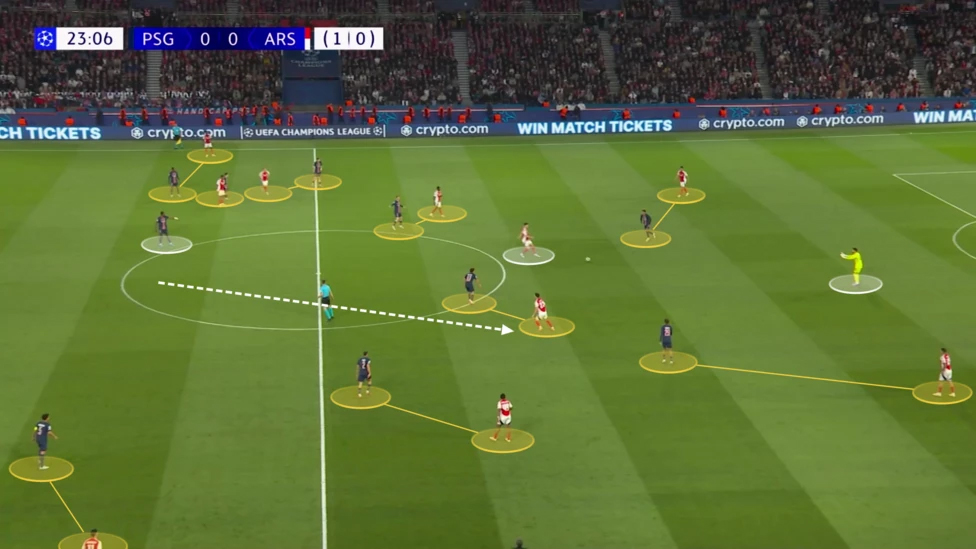
PSG push high with man-to-man pressing, but because Mikel Merino drops into central midfield and Willian Pacho does not track him, a PSG midfielder is forced to shift over to mark him. This leaves Declan Rice and David Raya (circled in white) as free players, enabling Arsenal to build play and move forward.
PSG’s three midfielders often have to shift to follow Merino, creating space for other Arsenal midfielders to receive the ball and advance the team. Although Swedish striker Viktor Gyokeres is in great form, both Merino and Kai Havertz are better suited to this tactic.
Against a team that presses aggressively, long diagonal passes are also a notable option. Merino and Havertz are adept at controlling or heading on goal kicks from goalkeeper David Raya, setting up second-ball battles for Arsenal’s midfield.
Gyokeres can also exploit long balls by challenging defenders on the flanks and running into the space behind the backline.
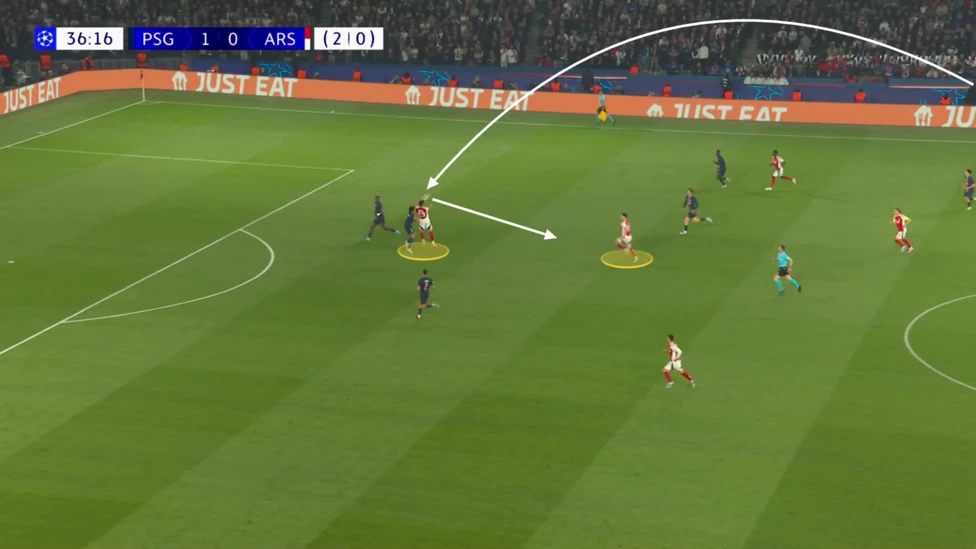
An example of William Saliba playing a long ball to Merino when PSG push high to apply pressure. Merino wins the physical duel and uses a header or touch to flick the ball on to Rice, who is in a good position behind.
The courage to play in tight spaces
Last season, Arsenal struggled greatly to score against PSG, largely due to the outstanding performances of goalkeeper Gianluigi Donnarumma. Although PSG have been very solid defensively this season, some teams—like Chelsea, RC Lens, and Bayern Munich—have still created dangerous chances against them.
The secret lies in positioning players close together to draw PSG’s man-marking system into crowded areas. This opens up other spaces on the pitch. Shifting the ball from congested zones to wider, more open areas has helped many teams break through PSG’s defense, especially through the middle.
Arsenal usually avoid risks in central areas and prefer safer attacks from the wings. However, against PSG, this might be a risk worth taking. Players like Leandro Trossard, Havertz, Bukayo Saka, Martin Zubimendi, and Eberechi Eze are capable of combining in tight spaces under heavy pressure and creating finishing opportunities through the middle.
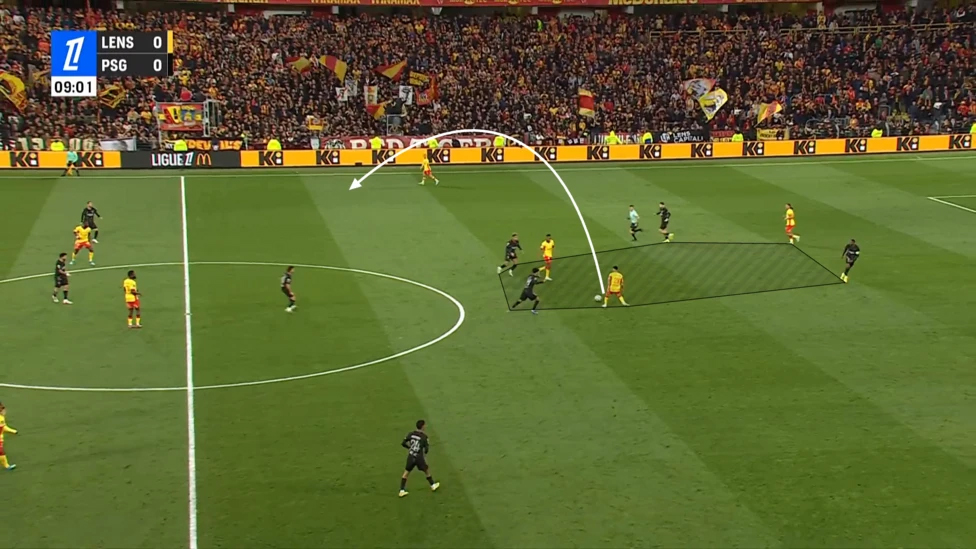
RC Lens, like Chelsea in the Club World Cup, positioned their central midfielders close together. This drew PSG’s midfielders into that area before they played passes to less crowded spaces.
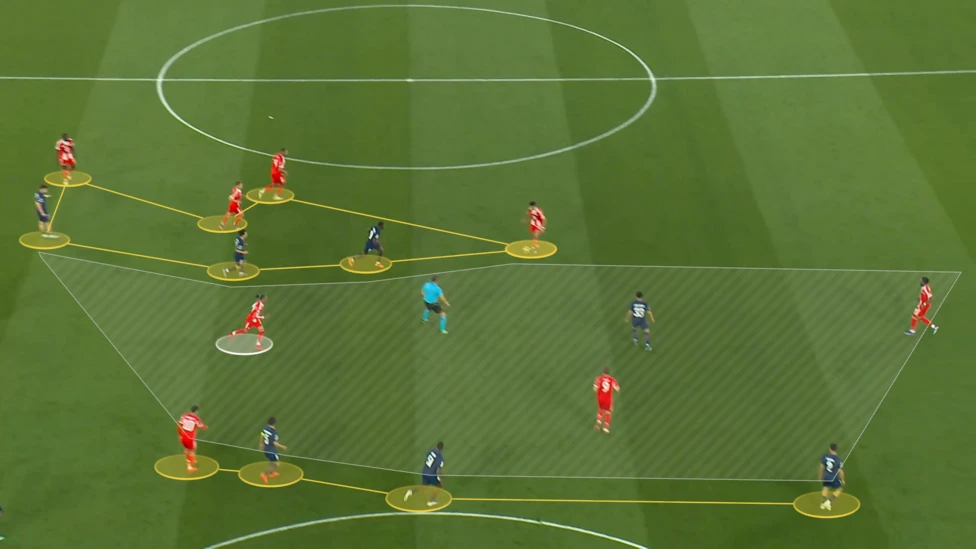
Michael Olise (in white) scored against PSG from this situation. Notice four Bayern players dropping deep and standing close together, attracting three PSG players to press. When this area became congested, space opened up elsewhere on the pitch (gray square), which led to the goal.
How can Arsenal stop PSG’s fluid attack?
Khvicha Kvaratskhelia is one of the most dangerous attacking players in the world right now, and Arsenal will need to find a way to minimize his impact.
Under Luis Enrique, PSG operate with great flexibility but still follow certain tactical principles. The French side always maintain players in key areas: two center-backs, two wide positions, and a center forward. What is special is that who occupies those positions is not crucial, as the players constantly swap roles.
These rotations help PSG disrupt the opponent’s defensive structure. Kvaratskhelia usually stays on the left flank and stands out for his off-the-ball movement.
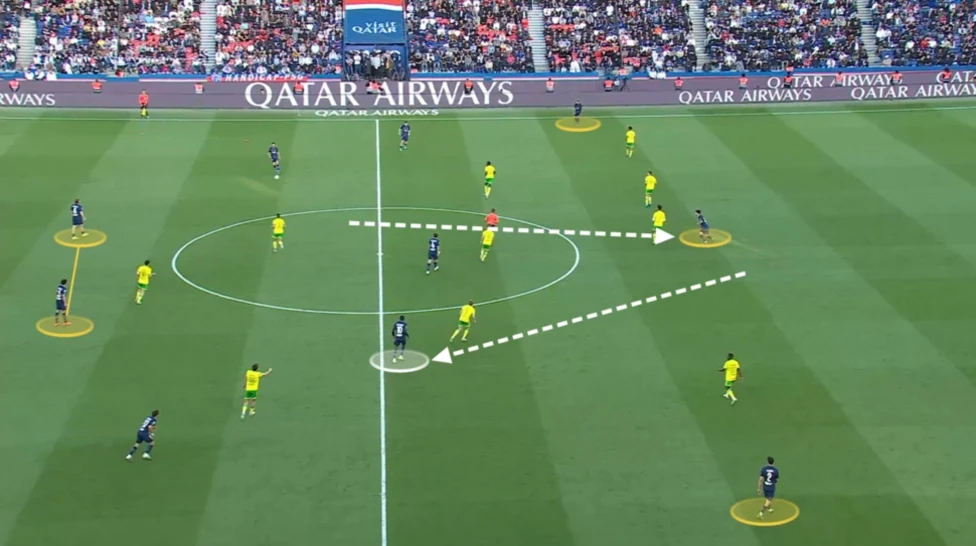
The yellow zones show five areas on the pitch where PSG always try to keep a player present at all times. Meanwhile, players in the midfield areas are allowed more freedom to move. In this example, the center-forward position is taken by a midfielder pushing up because Ousmane Dembele dropped into the midfield zone.
In the match against Bayern this season, Desire Doue frequently dropped deep to receive the ball. In one instance, Doue had time on the ball because he was not pressed strongly enough. Kvaratskhelia repeatedly feigned runs behind the defense before checking back to receive, then suddenly accelerated.
Those movements froze the Bayern defender, allowing Doue to play a pass for a teammate to run onto and score.
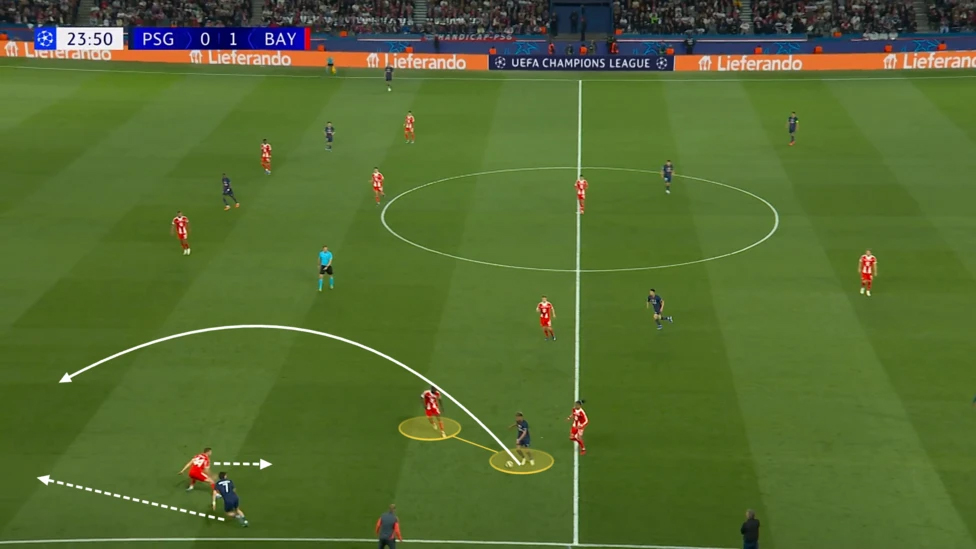
Khvicha Kvaratskhelia’s feints caused Josip Stanisic to step up at the wrong time, leaving him unable to track the run behind the defense. Meanwhile, Dayot Upamecano did not press decisively enough, giving Desire Doue space to play the decisive pass.
To neutralize PSG, Arsenal must make a clear choice: either tightly track players who drop deep to deny them time to pass, or deliberately drop back to protect the space behind the defense.
After falling 1-0 behind in the first leg of last season’s semifinal, Arteta adjusted the defensive system. He revealed after the match: "We fixed a problem after about 15-20 minutes, and that completely changed the game." Martin Odegaard’s pressing role was altered to prevent PSG from reaching midfield. At the same time, William Saliba closely marked Ousmane Dembele, even when the player dropped very deep.
That view aligns with the opinion of coach Enzo Maresca after Chelsea’s 3-0 win over PSG in the Club World Cup: "The idea was to play one-on-one. PSG are too good. If you give them time, you will have a lot of difficulties. You have to press them with extremely high intensity."
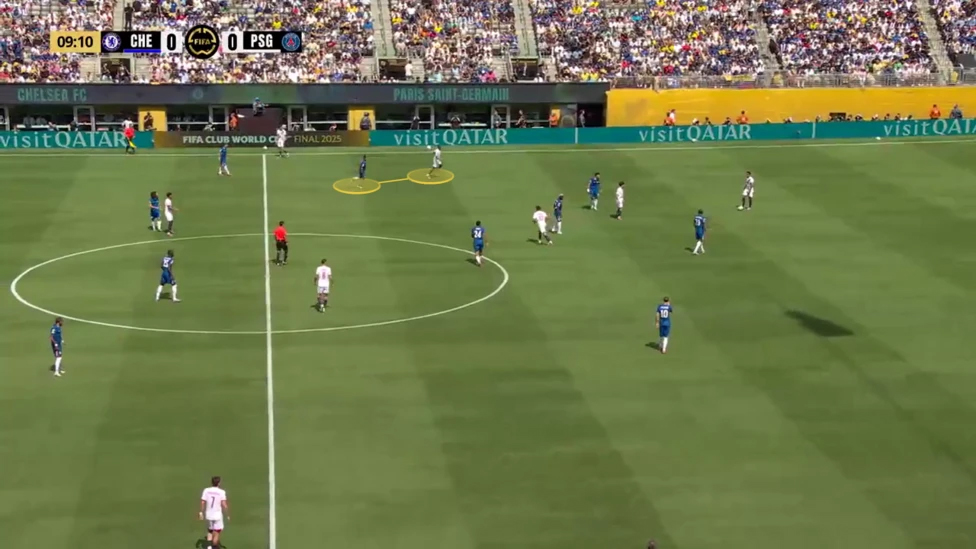
In Chelsea’s win over PSG in the Club World Cup, center-back Levi Colwill was frequently seen pushing high to press Dembele, even though the French forward moved into awkward, unconventional positions.
Set pieces could decide the final
It would be remiss to discuss Arsenal’s ability to beat PSG without mentioning their most potent weapon this season: set pieces. PSG have conceded only 29 goals in the domestic league this season, but six of those came from dead-ball situations excluding penalties. With a squad not overly dominant in physical stature, this is clearly a weakness for the French side.
Under coach Thomas Frank, Tottenham scored three goals against PSG in the Champions League, including one from a corner. They also scored both goals in a 2-2 draw in the European Super Cup from floated free kicks. The common thread in these goals was targeting the far post before heading the ball back across for a teammate to finish or sending it directly toward goal.

Gabriel is a major threat to opposing defenses from Arsenal’s corner kicks
PSG often struggle to deal with crosses that go over the heads of their defenders while they are retreating. When the ball is headed back the opposite way, its direction is completely against their defensive momentum, giving the attacking team an advantage. Arsenal even possess more dangerous set-piece specialists than Tottenham. So if they can push high and win many corners or free kicks, they have every chance of making a difference.
While no one can prevent moments of genius from PSG, the tactical analysis above shows that Arsenal have enough reason to believe they can hurt the reigning champions and realize their dream of winning the Champions League.


Wonderfulshortvideo
messi goal today messi assist today messi highlights vs egypt enzo fernandez goal today romero goal today argentina goals today argentina 3-2 egypt



“Wonderful player, fantastic player, could not run” 😅

Neville, Keane and Wright DO NOT agree on the future of Argentina in the World Cup 👀
“It gave you everything” 👀
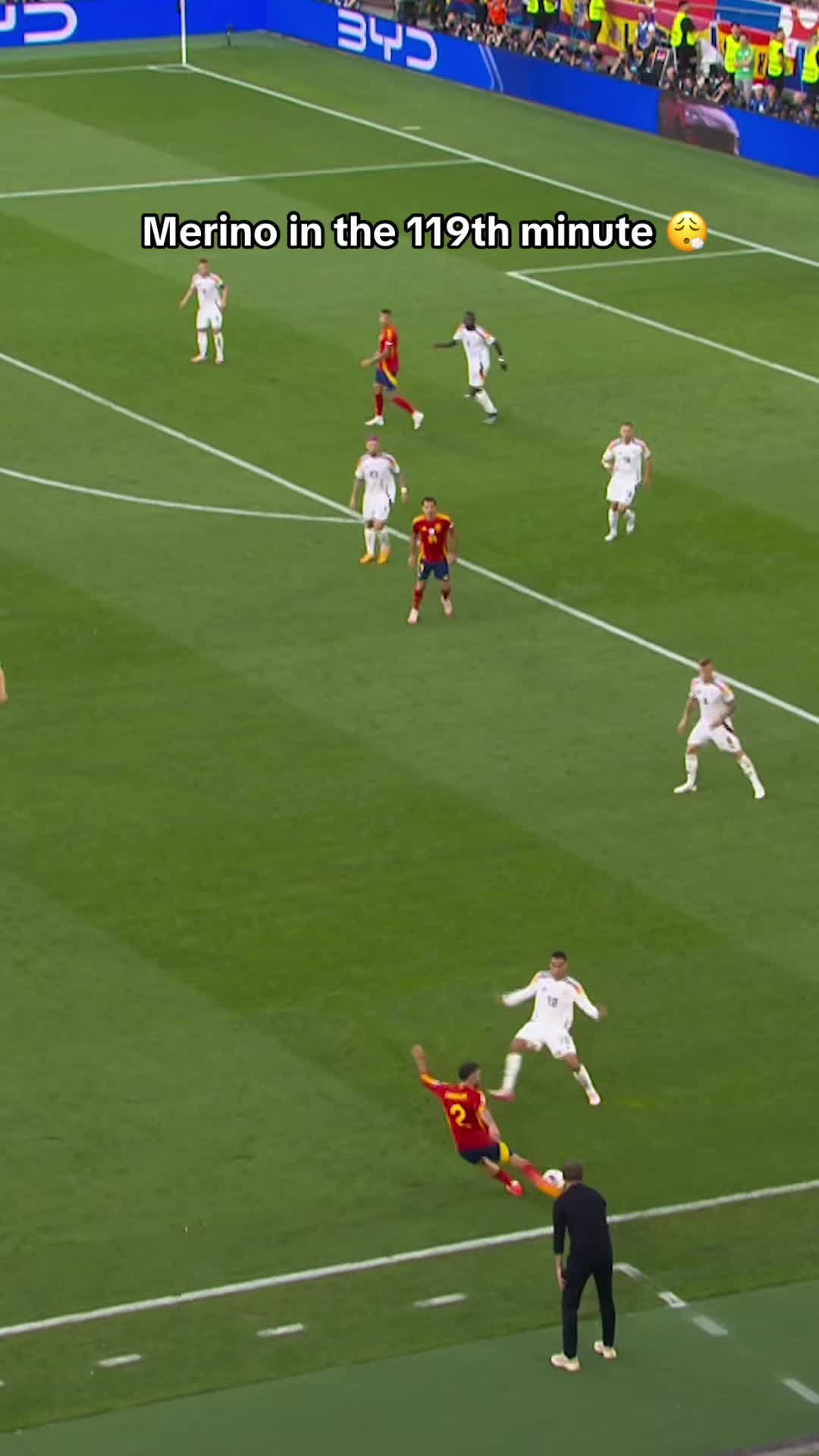
Clutch Merino 😮💨
merino goal today portugal 0-1 spain ronaldo interview today ronaldo retirement retiring
kane goal today kane highlights today england 2-1 congo
 Links
Links
 Contact
 App
App


