



Coffee of the week: PSG is not football's nouveau riche



Once upon a time, any discussion of PSG was accompanied by disdain for the funds poured into the team, claims that history cannot be created in a day, accusations of being football's upstarts, and words that dismissed the results they had achieved.
1. Until the final whistle of the 2025/26 Champions League final blew, The Athletic immediately published an article pouring cold water on PSG's second consecutive title.
When there is nothing left to criticize, the writers of this renowned sports site argue that PSG represents the opposite of their Qatari owners: They condemn the country's exploitation of migrant workers, restrictions on women's and LGBT rights, and limits on free speech. They claim PSG is now a geopolitical tool. It's a line of reasoning that urges people not to be fooled by this championship—still just a product of the nouveau riche.
Basically, many people still refuse to acknowledge that PSG is one of the greatest teams we've ever seen, and that this sporting project has long moved past a short-term phase toward the core of a real club: beautiful, philosophical play, with names that fit together rather than disjointed stars.
PSG has gone through many stages to reach its current version. When Qatar Sports Investments (QSI) bought the club in 2011, it was a famous club with a certain tradition but no major achievements beforehand. After 15 years, everything has been perfect: PSG has won 12 of the last 14 Ligue 1 titles and two consecutive Champions League trophies.
2. From a business perspective, this has also been a legendary deal: QSI spent only €70 million to buy the club 15 years ago, yet Arctos's purchase of 12.5% of PSG's shares in 2023 valued the entire club at around €4.25 billion!
Even in terms of transfer policy, this team has gone through various phases to reach a balanced, collective-minded squad like the one today.
Initially, they bought big stars past their prime, though still effective, such as Zlatan Ibrahimovic and David Beckham. These players laid the initial foundation, creating a skeleton for a team still searching for a philosophy.
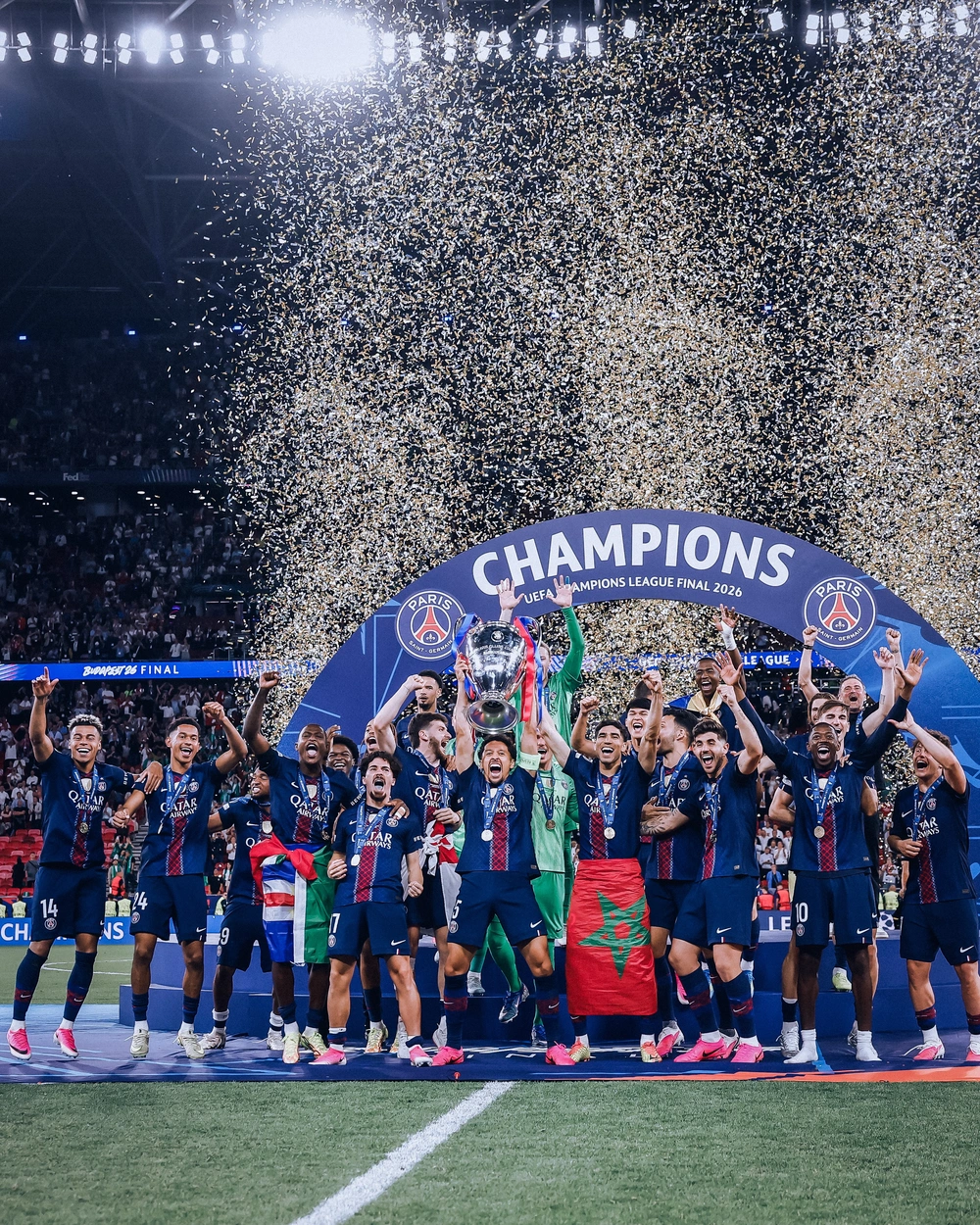
Who would have thought that a Ligue 1 club would come to dominate European football?
Later, they welcomed true Galácticos: Lionel Messi, Neymar, and Kylian Mbappé. This was a period focused on brand recognition rather than sporting development. They still dominated Ligue 1 but were underwhelming in Europe, with a style lacking collective identity.
In recent years, when Luis Enrique took charge, the philosophy completely changed: They were willing to let their biggest stars leave to focus on building a high-quality collective.
That's not the final evolution yet. Nasser Al-Khelaifi, chairman of QSI and PSG, says the ultimate goal is to have a team made up of the club's academy products, or at least many French players—something they haven't achieved yet: Only two French players started in this season's Champions League final, none of them from the local academy, though two former PSG academy graduates were on the bench.
All this shows that the second consecutive Champions League title and current status didn't happen overnight just because of money. QSI has managed this club through many stages to reach today.
3. Saying they bought success with money is an easy generalization, even an insult to this team's efforts. PSG is not only the best team in Europe and perhaps the world right now; they are certainly the most entertaining to watch.
Their full-backs could start for almost any other team. Watching them warm up with a rondo among the midfielders might be more exciting than many other teams' matches. Ousmane Dembélé has transformed from a talented but inconsistent, injury-prone winger into a Ballon d'Or-winning striker.
Désiré Doué is a breathtaking blend of speed, technique, and tactical awareness. Bradley Barcola could start for most Champions League sides, yet here he doesn't even have a spot. Then there's Khvicha Kvaratskhelia, a player who rose from a fairly ordinary starting point to become one of the best wingers in the world.
Some of their performances in this Champions League season make you conclude that this is football in its truest sense: fast, attacking, full of goals, structured yet unpredictable, collective yet preserving the individual flair.
Of course, there will always be voices trying to deny all this, simply because behind PSG are some of the richest owners on the planet. But having plenty of money and achieving success (especially in football) are two very different things. PSG themselves went through a phase with loads of money but completely lost direction. Perhaps they will face this prejudice for a long time, much like Chelsea did in the past or Manchester City does now. Yet deep down, even the critics must admit that the current PSG squad might be something that not even mountains of money could buy.


Wonderfulshortvideo
cristiano Ronaldo training


Cristiano Ronaldo 966 & 967 GOAL
Cristiano Ronaldo and Portugal in World Cup 2026
Rashford ⚽️
Cristiano Ronaldo 6x World Cup
My POV of THAT Raphinha goal
Jermaine Defoe is the new Woking manager
 Links
Links
 Contact
 App
App


