



Arsenal: The Dream Goes Beyond the Premier League


Despite falling short in the Champions League final in 2026, Arsenal enjoyed a successful campaign, clinching their first Premier League crown after a 22‑year wait.
Considering Manchester City's dominance in English football over the past decade, the 30‑year wait for Liverpool to win the Premier League, and Manchester United's 13‑year title drought, Arsenal's achievement holds immense significance.
Arteta's Great Achievement
It took nearly seven years and close to a billion pounds spent in the transfer market since Mikel Arteta's return to the Emirates, along with the absolute dominance of Man City and occasional challenges from Liverpool, for the London club to reclaim the top spot in England.
The Gunners won the world's most competitive league and reached the Champions League final just over three years after returning to the tournament, excelling in many aspects—from athletic to psychological. Arteta's team was a true defensive monster, keeping 19 clean sheets. They conceded only 27 goals in 38 matches, with the lowest expected goals against in the league (28.5), and allowed 0.71 goals per 90 minutes. Throughout the season, England's new champions faced just 90 shots on target and gave up only 2.4 big chances per game—both the lowest among Europe's top five leagues.
Despite not having a superstar striker like other top clubs, the London side's diversity and ability to decide matches were impressive. They scored 19 goals from set pieces, accounting for 35% of their total goals. Furthermore, they netted 16 headed goals and conceded only 7 from set‑piece situations.
Twelve different Arteta players scored in the Premier League. Viktor Gyökeres led the list with 14 goals. Most importantly, a remarkable psychological improvement brought stability and maturity to the Gunners. Despite a shaky April, Arteta's side won five consecutive matches in the final sprint to clinch the title a round early, finishing seven points ahead of Man City. This resilience was evident as most decisive winning goals came in the second half, and they held onto the top spot from Christmas to the championship.
Above all, they built a solid foundation, and the title relieved mental pressure, enabling Arsenal to potentially create an era of dominance.
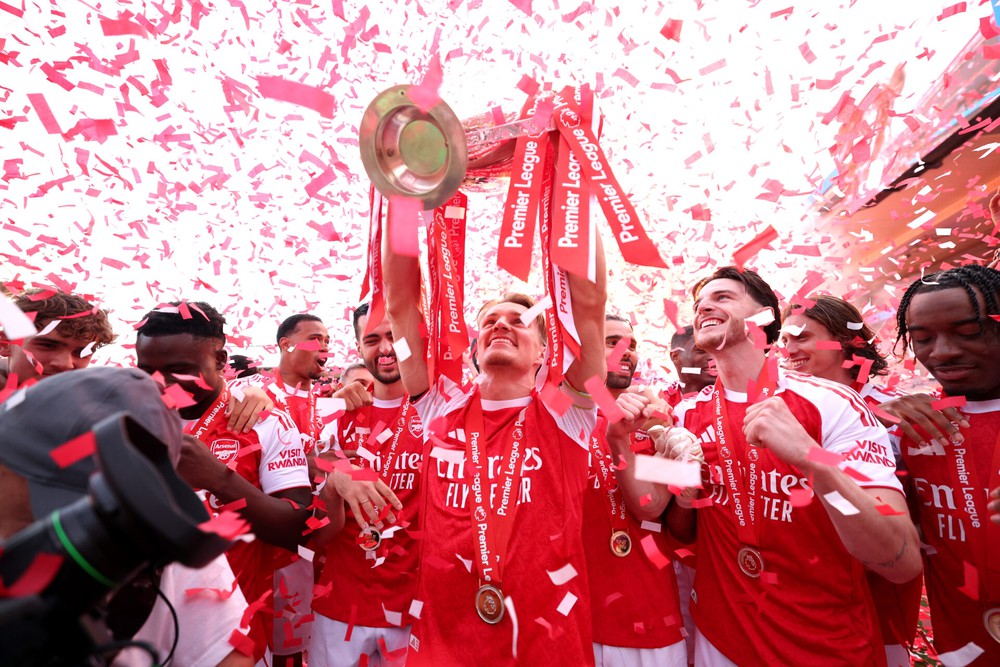
The Premier League title was Arsenal's greatest achievement of the past season.
Must Get Stronger
Arsenal won the Premier League, but they are not a complete team. They overcame many challenges thanks to structural solidity, excellent set‑piece ability, and unmatched consistency. However, Arteta's side did not achieve this by overwhelming opponents with dazzling attacking play or the finesse expected of world‑class teams.
The current challenge for the Spanish coach is to elevate the team from very good to excellent, from being the second‑best club in Europe to the pinnacle of football. The Gunners need to step up to a higher level in the next phase of Arteta's overall plan.
The gap in attacking and technical ability was clearly exposed in the Champions League final against PSG. The contrast showed that the London club needs to become more flexible, fluid, creative, and stronger by improving their forward line.
"We have to start making some very important decisions if we want to reach another level. And we will have to show that ambition because we are fully capable, but it requires being very, very ambitious, very fast, and very smart," Arteta said after the disappointing night in Budapest.
Now, the required upgrade is higher as the current group of players has only shown resilience, team spirit, and excellent defense. But the number of players who can help this team improve is very limited, and they need to achieve that by seeking high‑level resources in the transfer market.
After all, every team is improved by world‑class attacking talents. Arsenal responded to three runner‑up finishes by winning the Premier League. To go one step further and truly become European champions for the first time in club history, Arteta knows the team needs to do more, especially in attack.
The Premier League will continue to shake up European football next season with five Champions League participants: Arsenal, Man City, Man United, Aston Villa, and Liverpool. Three clubs will play in the Europa League: Bournemouth, Sunderland, and Crystal Palace (Conference League winners). Meanwhile, in the Conference League, they have one representative, Brighton – since Man City won the League Cup, the eighth‑placed team still qualifies.


Wonderfulshortvideo
cristiano Ronaldo training


Cristiano Ronaldo 966 & 967 GOAL
Cristiano Ronaldo and Portugal in World Cup 2026
Rashford ⚽️
Cristiano Ronaldo 6x World Cup
My POV of THAT Raphinha goal
Jermaine Defoe is the new Woking manager
 Links
Links
 Contact
 App
App


