



Vietnam National Team: 'A true test of fire'



Kim Sang Sik faces immense pressure from the back-to-back competitions in late 2026 and early 2027. This situation demands that Vietnam demonstrate the depth of its roster, solve the puzzle of form peaking, and exhibit flexibility.
Vietnamese football stands at a historic yet challenging crossroads in the latter half of 2026. Coach Kim Sang Sik now confronts a complex professional scenario, as two major tournaments—the ASEAN Cup and the new FIFA ASEAN Cup—are scheduled in quick succession, requiring the coaching staff to make truly groundbreaking tactical and personnel decisions.
According to the tentative schedule, the ASEAN Cup will end on August 26, 2026. Less than a month later, on September 21, 2026, Vietnam will begin their journey in the FIFA ASEAN Cup. The gap of under a month between these two events presents Coach Kim with a difficult decision regarding squad building, priority setting, and distribution of team strength.
In modern football, a cycle of less than a month is far too short for key players to both recover from an exhausting tournament like the ASEAN Cup and rebuild their workload to reach a new peak of form. If Vietnam advances deep into that traditional regional competition, the risk of overloading and injuries to the core players is a real concern.
While the ASEAN Cup still holds great sentimental value for Vietnamese fans, the FIFA ASEAN Cup offers superior practical benefits both professionally and economically. Being held during the FIFA international match calendar, this tournament gives victories more weight in the world rankings.
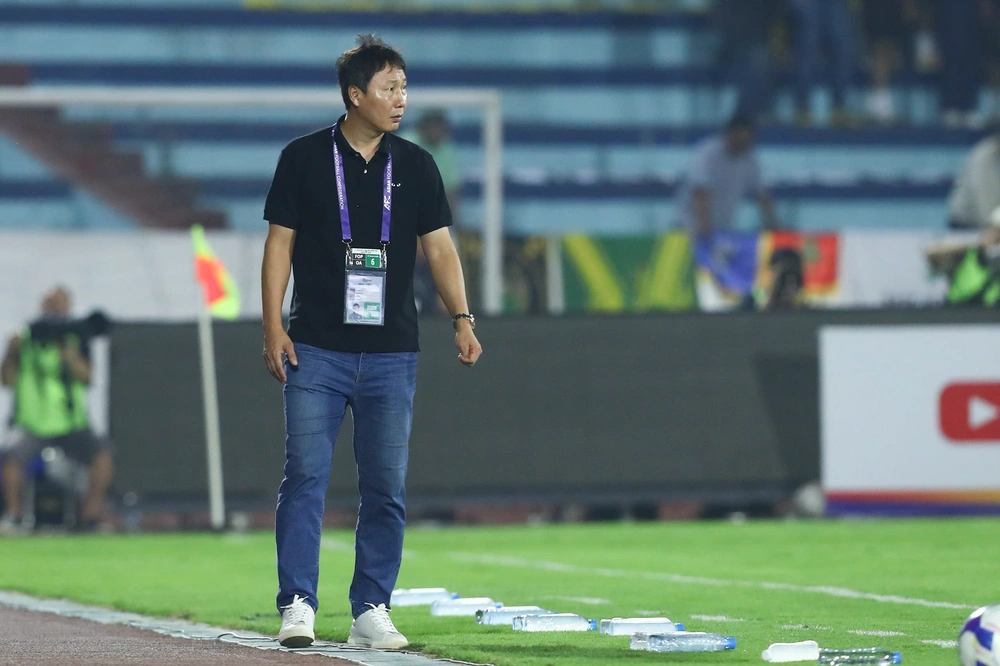
The upcoming tasks for Coach Kim Sang Sik with the Vietnamese team will be extremely challenging, with two major tournaments occurring back-to-back. Photo: Hoàng Linh
To resolve the dilemma between immediate results and long-term development and elevation, Coach Kim must change his personnel philosophy. Instead of relying on a fixed core of 15-17 players, Vietnam needs a deeper roster of at least 25-30 players with comparable quality.
According to the plan, right after the domestic leagues conclude in mid-June, the Vietnamese team will depart for a training camp in South Korea. This is considered a crucial period for Coach Kim and his staff to comprehensively reassess each player's physical foundation and tactical adaptability. In the South Korean tactician's philosophy, the concept of "meritorious veterans" is completely discarded.
The South Korean coach firmly adheres to the philosophy that "the national team is open to everyone," fostering a fiercely competitive environment based on actual performance in the V-League rather than players' reputations. This competition not only elevates squad quality but also boosts the fighting spirit of the entire team. For Coach Kim Sang Sik, real value on the pitch and the hunger to contribute are the only metrics.
Playing consecutive high-level tournaments requires Vietnam to have sufficient squad depth for rotation, preventing overload and injuries to key players. The combination of overseas Vietnamese players and naturalized talents like Xuân Son or Hoàng Hên will create roster depth. Under Kim's leadership, integrating overseas Vietnamese talents is no longer a stopgap measure but has become a key strategy to address squad rotation and elevate tactical strength.
Therefore, building a squad with continuity—combining the experience of core players with the youth of the U23 generation—has become an urgent necessity. The ability to rotate flexibly and allocate form peaks for each group of players will be the key for Coach Kim to overcome the pressure.
Despite facing many difficulties, the Vietnamese team has no choice but to adapt. Fans are waiting for a more flexible and tougher version under Coach Kim's leadership. The hardships and pressure will serve as a true test of the mettle and depth of Vietnamese football during this challenging transitional period.


Wonderfulshortvideo
cristiano Ronaldo training


Cristiano Ronaldo 966 & 967 GOAL
Cristiano Ronaldo and Portugal in World Cup 2026
Rashford ⚽️
Cristiano Ronaldo 6x World Cup
My POV of THAT Raphinha goal
Jermaine Defoe is the new Woking manager
 Links
Links
 Contact
 App
App


