



The Vietnam national team must dominate the region if they aim to reach higher levels.


The World Cup serves as the most vivid reflection of the distance between different football cultures. As France, England, Spain, and Argentina showcase high-speed, physically demanding, technically skilled, and well-structured football at the pinnacle, it also acts as a wake-up call for Vietnamese football ahead of the 2026 ASEAN Cup.
If Vietnam dreams of bigger milestones in Asia or the World Cup, the national team must first establish a dominant position in Southeast Asia through real strength, not just through moments of brilliance or luck.
The 2026 World Cup is delivering clear lessons about the development trends of modern football. There is no longer room for teams that only defend in numbers or rely on random moments of inspiration. The world's strongest teams share common denominators: robust physical foundations, extremely high ball circulation speed, flawless basic technique, constant pressing ability, and impressive squad depth.
France, England, Spain, and Argentina not only possess top stars but also a whole system that continuously produces talent. This uniformity creates sustainable class, making it increasingly difficult for other football nations to spring surprises. In modern football, the gap between strong teams and the rest is increasingly expressed through training quality, squad depth, and tactical adaptability speed.
That is also why Arsene Wenger once said Asian football is not yet up to standard to compete fairly at the World Cup. This statement may sting many, but it reflects the reality.
Even Japan, with almost its entire squad playing in top European leagues, has yet to surpass the quarter-final threshold. Saudi Arabia, which invested heavily in its domestic league with numerous world stars, also exited early. This shows that narrowing the gap cannot rely solely on money or a few outstanding individuals, but requires a comprehensive upgrade of the entire football ecosystem.
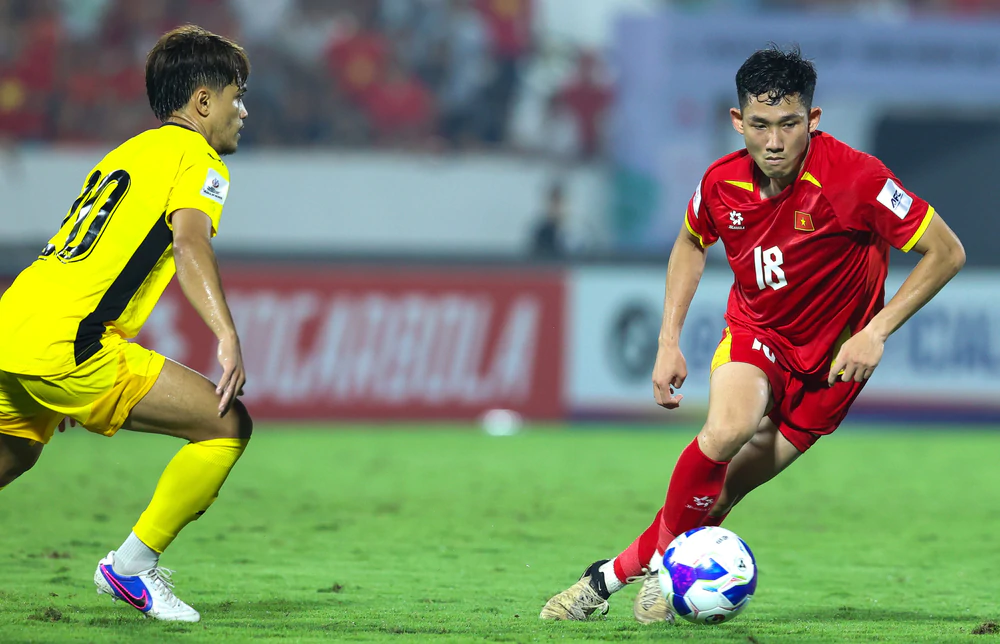
To secure a World Cup ticket, the Vietnam national team must demonstrate superior class against regional rivals like Malaysia. Ảnh: Hoàng Linh
Thus, the World Cup is not only a global football festival but also an opportunity for Vietnam and Southeast Asian nations to reflect on themselves. The 2026 ASEAN Cup will be a crucial benchmark for Vietnam's football position in the region. However, this is no longer a tournament where Vietnam or Thailand can automatically enter with a 'favorite' mentality. Indonesia is accelerating thanks to a wave of quality naturalized players from Europe. Malaysia is following a similar path. The Philippines continues to exploit players raised abroad, while Thailand keeps improving its domestic league.
In that context, the Vietnam national team under coach Kim Sang Sik needs to create a real advantage if they want to defend their throne. A championship won through grit is commendable, but to aim for Asia and the World Cup, Vietnam must build a dominant position through actual strength. The ASEAN Cup must be a tournament where Vietnam shows clear superiority in playing style, physicality, speed, and squad depth.
New factors, Vietnamese overseas players, naturalized players, and the young generation are creating positive competition within the team. This aligns with the trend of modern football, where no one is guaranteed a starting spot by reputation or past achievements. Constant competition will raise the team's quality, while also laying the foundation for long-term goals.
Further ahead, Vietnamese football can only become stronger if the V-League also changes. The league needs higher competitiveness, faster pace, and minimal time-wasting, petty tricks, and prolonged dead periods due to VAR or non-professional situations. Clubs must invest in sports science, medicine, nutrition, and data analysis to develop players comprehensively in terms of physicality, speed, and tactical thinking. Only when the foundation is elevated can the national team go far.
Looking from the World Cup to the ASEAN Cup, the biggest lesson is realism. Vietnam cannot think about the World Cup if they have not yet created a sufficient gap with their Southeast Asian rivals. The 2026 ASEAN Cup, therefore, is not just a race to defend the championship, but also a stepping stone for Vietnamese football to get closer to the big dream called the World Cup.


Wonderfulshortvideo
BARCELONA REVENUE barcelona news today



Lashed home by Kieffer Moore ☄️

The saxophones are getting louder for Preston here…
When football is simple but beautiful 😍

Cristiano Ronaldo is back on the quest for 1,000 goals, and these are his 977th and 978th goals.
messi argentina retirement messi retiring messi edit

The Swans go TOP of the Championship 🦢
 Links
Links
 Contact
 App
App


