



The Vietnam national team is striving to break through its limits.



On the eve of the 2026 ASEAN Cup, the Vietnamese squad held a training session in South Korea featuring elevated screening standards, harsher conditions, and clearly more competitive dynamics. Within such an environment, safety is no longer an option.
A packed schedule of tournaments lies ahead for the Vietnam team. This forces the coaching staff to make truly innovative tactical and personnel decisions. Here, the ASEAN Cup still holds great emotional value for Vietnamese fans, while the FIFA ASEAN Cup offers superior practical benefits in both professional and economic terms. This tournament is held during FIFA Days, a key factor that gives victories more weight on the world rankings.
Therefore, building a squad with continuity—blending the experience of key players with the youthful energy of the U23 generation—has become an urgent necessity. Flexible rotation and the ability to manage players' peak form across different groups will be the key for Coach Kim Sang Sik to handle the pressure. Given that regional rivals like Indonesia and Malaysia are increasingly naturalizing players and upgrading their squad quality, rejuvenation and expanding the talent pool are inevitable.
The history of the ASEAN Cup has shown that the Vietnam team's success does not rely solely on star performances, but on a smoothly operating system and a spirit of collective sacrifice. Therefore, the players selected at this time must not only possess talent but also demonstrate their capability, composure, experience, and current form.
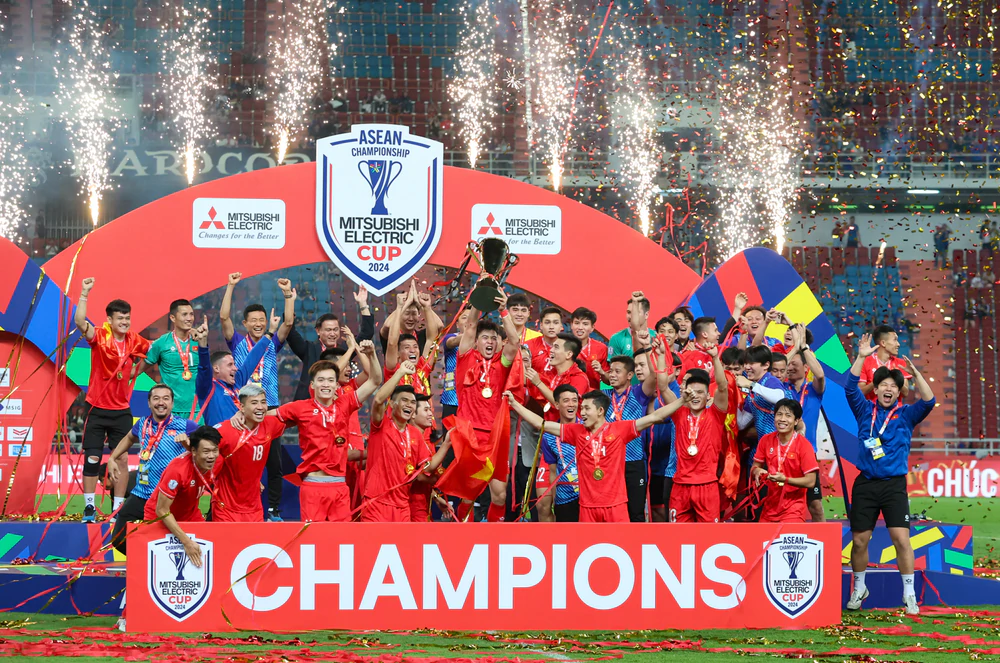
The Vietnam team has never successfully defended the AFF Cup/ASEAN Cup title in its history. Photo: Hoang Linh
It is evident that Coach Kim Sang Sik is gradually building a long-term personnel framework, not just for the 2026 ASEAN Cup. The strongest squad under the South Korean tactician is being shaped through each match of the 2027 Asian Cup qualifiers, via continuous rotation, experimentation, and screening from the V-League "crucible," while also receiving a fresh boost from the U23 generation.
This diversity provides the "raw material" for Coach Kim Sang Sik to craft various tactical approaches, rather than relying on a few individuals or a fixed generation as before. If properly executed, this could serve as a foundation for the team to avoid the old cycle: periodic bursts of success followed by a rapid decline when key players lose form or when the squad suffers from gaps in personnel.
It can be seen that Coach Kim Sang Sik's current challenge is not finding talented players, but having the courage to create quality options to build a cohesive team. This shows that the personnel foundation of Vietnamese football has reached a level of maturity, ready for greater challenges in the regional arena.
Despite facing many difficulties, the Vietnam team has no choice but to adapt. Fans are waiting for a more flexible and tough version under the leadership of Coach Kim Sang Sik. Difficulties and pressure will serve as a true "litmus test" for the character and depth of Vietnamese football during this challenging transition period.


Wonderfulshortvideo
BARCELONA REVENUE barcelona news today



Lashed home by Kieffer Moore ☄️

The saxophones are getting louder for Preston here…
When football is simple but beautiful 😍

Cristiano Ronaldo is back on the quest for 1,000 goals, and these are his 977th and 978th goals.

messi argentina retirement messi retiring messi edit

The Swans go TOP of the Championship 🦢
 Links
Links
 Contact
 App
App


