



Hosting the World Cup at Home: Football, Business, and the Question of Who to Sell To?


A ticket to the 2026 World Cup final can cost up to nearly $33,000. A piece of grass cut from the very pitch where the match will be played, sealed in a acrylic box with a USB drive, is sold for $3,000. At first glance, this seems absurd. But looking closer, it is the most honest portrait of industrial-era football: a sport that no longer sells matches, but sells memories, sells emotions, and sells even... grass.
The issue is not whether FIFA is greedy. The issue is: why do people still buy?
FIFA announced it will sell up to 2,026 pieces of grass per category, cut from the New Jersey New York Stadium, where the final will take place on July 19. Prices range from $450 to $1,200 for three standard tiers, while the top-tier premium version costs $3,000 and includes a gold-plated replica ticket, a miniature ball, and a crystal trophy model. It is estimated that this alone could generate over $11 million.
Meanwhile, just a few days earlier, nearly 1,200 second-tier tickets for the final were publicly listed at $7,380 each, not to mention first-tier tickets ranging from $19,995 to nearly $33,000, and VIP tickets up to $34,500. On FIFA's official resale market, some tickets were listed at up to $11.4 million.
These two stories—seemingly separate, one about selling memorabilia and the other about selling tickets—are actually one and the same. They both answer the question: Who does football sell to, and why are people willing to pay that price?
Criticizing FIFA for "price gouging," polarizing the sport, and turning the tournament into a commercial product not meant for the masses is an understandable but biased reflex. After all, an organization can only set such high prices when one prerequisite exists: the buyers truly exist and are ready to pay. FIFA does not create demand by magic. They are simply exploiting to the fullest something that already exists—a World Cup where North America, especially the US, with its world-class entertainment spending power, has genuinely been living in a football atmosphere for over a month.
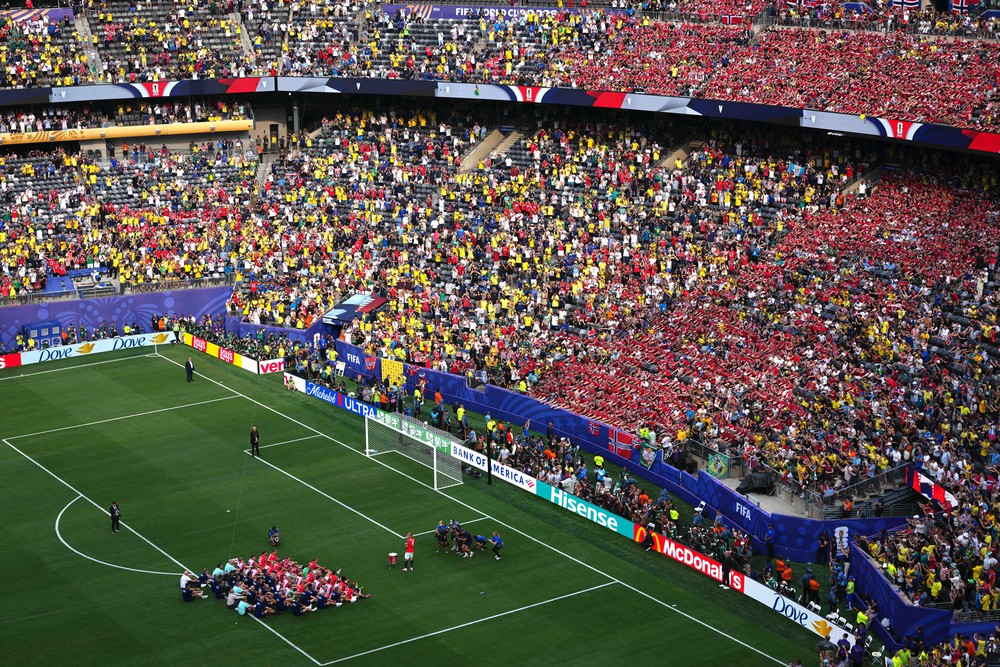
FIFA announced it will sell up to 2,026 pieces of grass per category, cut from the New Jersey New York Stadium, where the final will take place on July 19. Photo: Xinhua/VNA
This is the key difference from the usual worry of major tournaments: the fear that audiences will be fragmented across too many platforms and entertainment choices. The 2026 World Cup shows the opposite. Instead of letting fans scatter, FIFA has focused their attention on a single point: the stadium, the match, the irreplaceable live moment. With that concentration, they are confident enough to push prices to seemingly absurd levels.
In other words, making money is just the tip of the iceberg. The root is the real audience.
This is where football—and not just football—in many developing sports scenes often gets confused. People tend to view sports economics as a matter of media, sponsorships, and flashy promotional campaigns. But the history of football's economic development, from the English Premier League in the 1990s to the World Cup itself, gives the same answer: sustainable revenue only comes after there is a real community of fans willing to spend money, time, and emotions to attend the games.
The term "fan," over time and circumstance, may differ in how they watch the game, but the essence remains the same. Those who buy season tickets or those who subscribe to year-round TV packages might all be labeled the same way in today's era: user—real users.
One-time viewers, driven by curiosity or the viral nature of an event, represent short-term revenue. Multi-time viewers, driven by love for a jersey, a team, or childhood memories tied to a match, are the long-term asset. Football's commercial product, in the end, is not sold to fleeting crowds. It is sold to memories. And memories are only created by matches that are good enough, dramatic enough, and fair enough for people to want to remember.
This is the systemic flaw that many football communities, including Vietnam's, often make: betting everything on media and events while neglecting the root—competitive quality and the live experience. A tournament can hold grand press conferences, invite stars, and make beautiful posters, but if the stands are empty of real spectators, if the match's flow is not compelling enough to bring people back a second time, if players don't play for the colors and the shirt—the natural catalyst that brings them closer to the audience, even if they are from another region—then all marketing efforts are just a coat of paint on a hollow foundation.
Sports, whether amateur or fully industrialized, have only one foundation: real viewers, physically present in the stadium. Those who build this foundation have the right to set prices. Those who skip it and rush straight to collecting money are selling something no one wants to buy.

 リンク
リンク
 連絡先
連絡先
 アプリのダウンロード


