



Yinchuan Four-Nation Tournament: 2009-born National Youth Team Focuses on Two Areas of Improvement



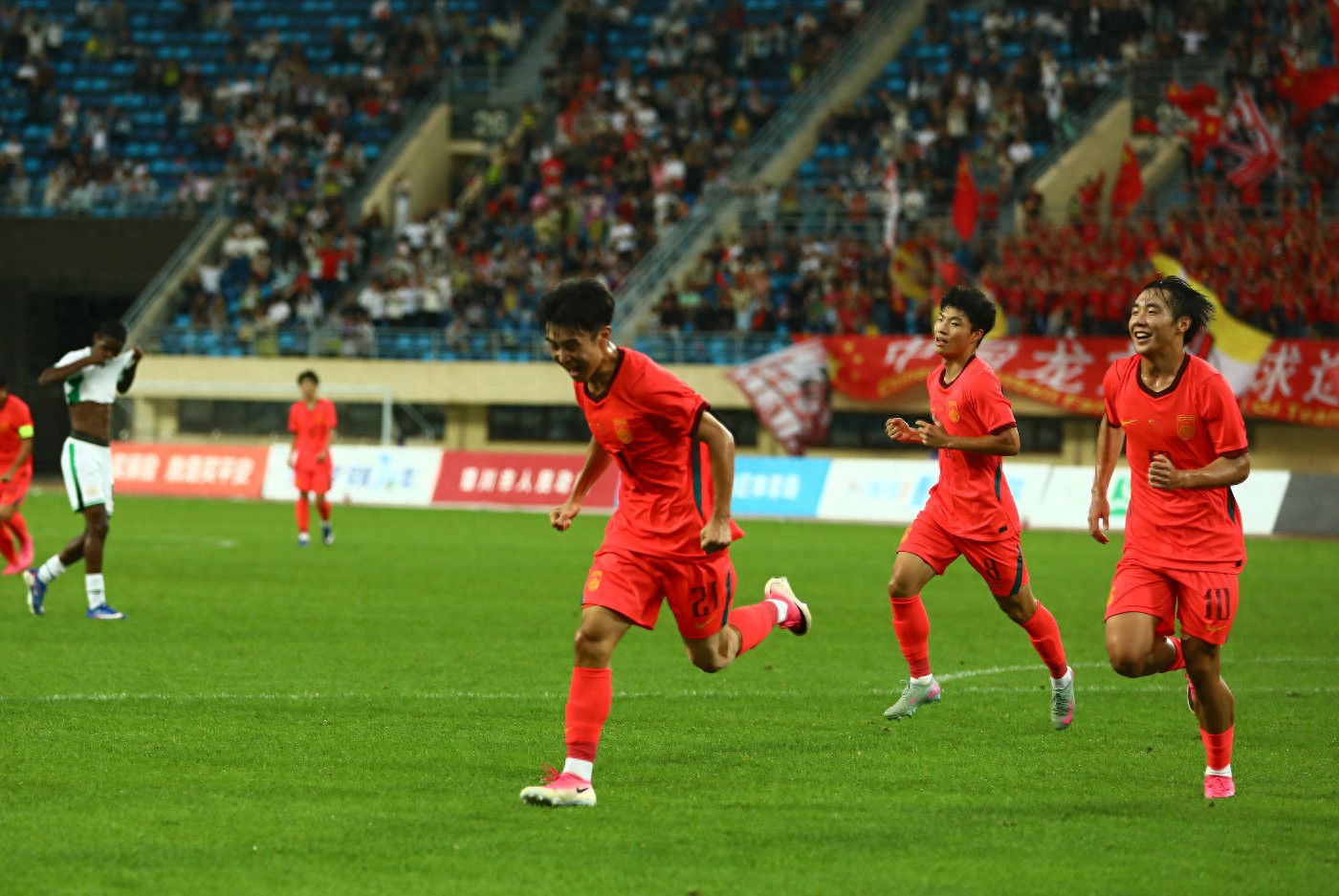
Report by Chen Yong On July 11, the 2009-born team managed a 1-1 draw against Nigeria's U17 side, ultimately placing second in the Yinchuan tournament with a record of one win, one draw, and one loss (four goals for, three against). The squad that participated was not their strongest, as key players Wan Xiang and Kuang Zhaolei were absent. However, the opponents in Yinchuan were formidable, offering higher intensity and faster pace, which posed a greater challenge for the team. This serves as an important step in preparing for the U17 World Cup and is a necessary part of the young players' development.
Facing Opponents of Different Strengths
After securing qualification for the U17 World Cup, the 2009-born team's friendly opponents have also been upgraded. Tanzania's U17 side was clearly a step up in strength, while Australia's U17 and Nigeria's U17 (actually U16) teams were slightly weaker but still offered good pace and intensity.
In the Yinchuan tournament, Tanzania's U17 team—runner-up of the U17 Africa Cup of Nations and fielding its strongest lineup—proved to be the toughest opponent. The 2009-born team lost 0-2 to them in the second match. This opponent can be compared to Cameroon from last year's Montaigu Tournament: Tanzania was the U17 Africa Cup runner-up, while Cameroon failed to reach the semifinals. Moreover, the 2009-born team's lineup was significantly weaker than during Montaigu, as several top players at goalkeeper, center-back, defensive midfielder, and forward positions had left the national youth team for personal reasons, Liang Shiyu was sidelined by injury, and Wan Xiang and Kuang Zhaolei were absent. Last year at Montaigu, the 2009-born team beat Cameroon 1-0; this time they lost 0-2 to Tanzania. After the match, the players reflected on the gaps in intensity, pace, speed, and technique.
In contrast, Australia's U17 squad differed greatly from the one that participated in the U17 Asian Cup, as they used this tournament primarily to evaluate players. The 2009-born team easily defeated them 3-0 in the opening match. Although the opponent was mainly testing its roster, the convincing win still reflects progress in Chinese youth football, especially given that the 2009-born team itself was missing key players.
Against Nigeria's U17 team, the 2009-born side had opportunities to win, creating two good chances late in the game—including one with an open goal—but missed both, resulting in a 1-1 draw. Despite being one year younger, Nigeria's players applied intense pressure in the frontcourt, causing considerable difficulty for the Chinese team.
It must be emphasized: qualifying for the U17 World Cup is extremely important for this group of players. For instance, the 2008-born national youth team disbanded after failing to qualify. In contrast, the 2009-born team not only gets to compete in the World Cup but also gains access to more high-quality matches during preparation—a truly invaluable experience.
Need to Avoid Backline Passing Risks
Overall, the 2009-born team performed steadily in the Yinchuan tournament, showing good commitment. On the offensive side, their long-ball counterattacks were clear and effective, with striker Zhao Songyuan again standing out as a reliable scoring threat. For Zhao, the key to further improvement lies in systematically participating in higher-level competitions, such as professional leagues or overseas stints.
The team conceded three goals in the tournament. The goal against Nigeria came from a corner kick—during the defense, a Chinese player failed to mark tightly and even lost advantageous position, allowing the opponent to head the ball in.
The two goals conceded against Tanzania: the second came from a defensive error—similar mistakes were not uncommon in that match, highlighting the team's weaknesses under strong opposition, fast pace, and high pressure. The first goal resulted from a miscommunication between the backline and midfield: a defender attempted a through ball to a midfielder, who mishandled the ball, leading to a turnover and quick counterattack. Similar mistakes occurred during the U17 Asian Cup, and such errors near the box are extremely costly. Furthermore, at least two Chinese defenders were near the Tanzanian scorer but failed to make correct decisions during their retreat.
Compared to the pragmatic and highly direct style of former coach Antonio, current head coach Ushijima Satoshi, while also utilizing long balls for attacks, demands more in terms of passing and possession. He hopes to build up play in attack and maintain greater control of the ball to avoid constantly surrendering possession and tiring out the team. This approach works well against average opponents, but against clearly superior teams, their passing becomes a vulnerability that opponents can exploit.
This concern will become even more pronounced during the U17 World Cup. Expecting the young players to rapidly and comprehensively improve their passing ability is unrealistic. The solution must focus on two aspects: first, passers need to have sufficient awareness of risks; second, after backfield errors, all players must stay highly focused, especially avoiding lapses in marking and leaving opponents unguarded.

 リンク
リンク
 連絡先
連絡先
 アプリのダウンロード


