



FIFA considers expanding the World Cup to 64 teams: How will the format change, and will Vietnam's national team have a better chance?



FIFA is reviewing the option of expanding the 2030 World Cup to 64 teams. What would a 64-team World Cup look like in reality?
The 2026 World Cup will be the largest tournament in history, increasing the number of participating teams from 32 to 48, co-hosted by the United States, Canada, and Mexico. However, even before that tournament concludes, discussions about an even bigger World Cup have already begun.
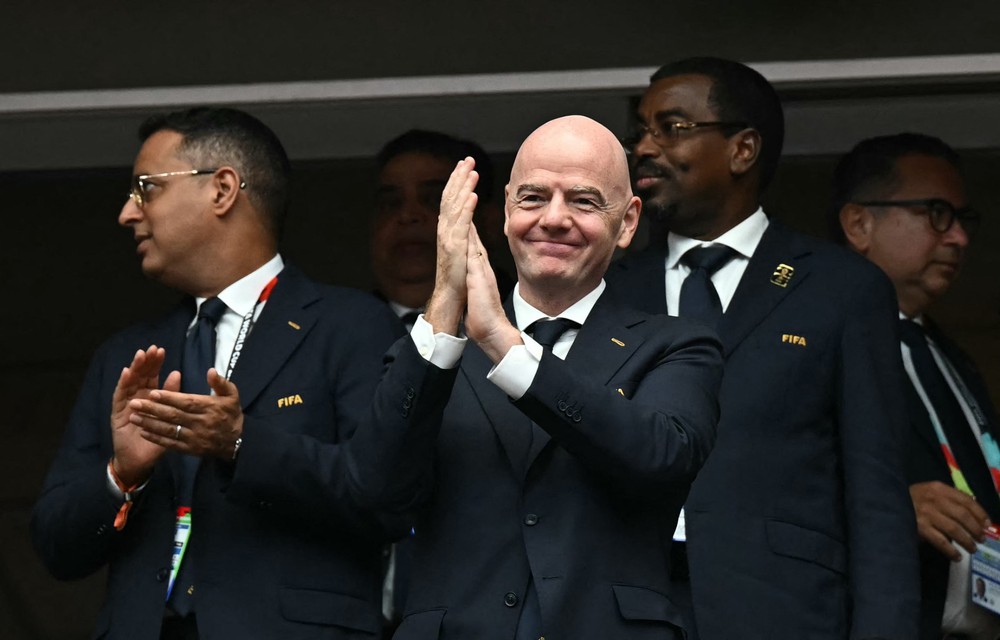
FIFA President Gianni Infantino confirmed that the possibility of raising the World Cup to 64 teams will be considered — Photo: AFP
FIFA President Gianni Infantino confirmed that world football's governing body will examine the feasibility of expanding the World Cup to 64 teams, starting as early as the 2030 edition.
This proposal could transform the entire tournament, from qualification to the final match. So how would a 64-team World Cup be organized?
The most likely format: 16 groups of 4 teams each
If FIFA decides to expand to 64 teams, the simplest and most logical approach would be to adopt the model used for the World Cup from 1998 to 2022 (when the tournament had 32 teams), but doubled in scale.
Accordingly, the World Cup would have 16 groups, each with 4 teams. Every team would play 3 group-stage matches. The top two teams from each group would advance to the knockout stage.
After the group stage, the tournament would follow the usual path: round of 32, round of 16, quarter-finals, semi-finals, and the final.
In total, a 64-team World Cup could feature 128 matches, double the 64 matches of the 32-team era and significantly more than the 104 matches planned for the 2026 World Cup.
Why not use groups of 3 teams?
When designing the format for the 2026 World Cup, FIFA considered the option of groups of 3 teams but ultimately abandoned it due to concerns about fairness and the risk of match-fixing through collusion.
For a 64-team World Cup, FIFA is also likely to avoid the 3-team group model for similar reasons: uneven rest periods between teams, potential for manipulated results, and less exciting final group-stage matches.
Returning to the 4-team group format is seen as ensuring balance and competitiveness, even though the number of matches increases significantly.
How will qualification change?
This is perhaps the biggest change. With up to 64 teams in the final tournament, nearly one-third of FIFA's over 210 member associations would secure a World Cup spot.
Some regions could see the majority of their teams qualifying for the finals.
For example, South America (CONMEBOL) already has 6 direct slots for the 48-team World Cup. If the tournament expands to 64 teams, that number is likely to increase further, meaning very few South American teams would fail to qualify.
Supporters believe that more countries will have the opportunity to develop and compete on the world's biggest football stage.
Additionally, Asia could also see an increase in World Cup slots. This would mean a greater chance for Vietnam's national team as well.
Match schedule and organization: Major challenges
A 64-team World Cup would be unprecedented in scale. FIFA would have to address numerous issues: the tournament could last longer than a month, requiring more host cities and stadiums. The workload and recovery time for players would face greater pressure.
Notably, the 2030 World Cup is already planned to be held across multiple continents, with matches in South America, Europe, and Africa. If expanded to 64 teams, organization would become even more complex.
Why does FIFA want to expand?
FIFA President Gianni Infantino believes that expanding the World Cup aligns with the goal of globalizing football. According to him, more participating teams means more countries are represented, thereby boosting investment and football development worldwide.
This proposal also receives support from many countries, especially in South America, as they hope the 2030 World Cup, marking the 100th anniversary, will feature more teams.
However, not everyone is convinced by this idea. Many critics, including leading figures in European football, argue that the tournament could become too long and diluted, with group-stage matches losing competitiveness, and that qualifying for the World Cup would no longer hold as much prestige as before.
Furthermore, player health and fitness are major concerns, as the already packed global football calendar risks being stretched even further.
The World Cup has undergone several major changes in its history, from 16 teams to 24, then 32, and now 48. Expanding to 64 teams would be the biggest overhaul the tournament has ever seen.
At present, this is just a proposal. However, with FIFA confirming it will put this matter up for discussion after the 2026 World Cup concludes, the option of expanding to 64 teams is clearly on the table. And if it becomes a reality, the World Cup as we know it will change completely.


Wonderfulshortvideo
BARCELONA REVENUE barcelona news today



Lashed home by Kieffer Moore ☄️

The saxophones are getting louder for Preston here…
When football is simple but beautiful 😍

Cristiano Ronaldo is back on the quest for 1,000 goals, and these are his 977th and 978th goals.
messi argentina retirement messi retiring messi edit

The Swans go TOP of the Championship 🦢
 Links
Links
 Contact
 App
App


