



STATISTICS: England team flies half around the Earth at 2026 World Cup, double Argentina, 7 times France



Based on recent data, England's squad has traveled more than 14,000 miles (22,000 km), the highest distance at the 2026 World Cup. That's twice as much as Argentina and seven times France's travel.
England team at the 2026 World Cup: Flying 22,000 km across North America
A World Cup held across three countries was always expected to present unprecedented challenges. With 16 host cities spread across North America, teams are forced to travel longer distances than any previous World Cup finals to claim the prestigious golden trophy.
But even though all teams must adapt to the enormous geographical distances, some have traveled significantly more than others. England is a prime example. Thomas Tuchel's squad has flown over 14,000 miles (22,000 km, equivalent to more than half the Earth's circumference) to reach the semifinals. This distance is about seven times that of title contenders France and considerably more than their opponent Argentina.
Reason: The Three Lions set up their base camp in Kansas City, Missouri, but constantly had to fly out and back to play in Atlanta, Boston, Mexico City, and Miami.
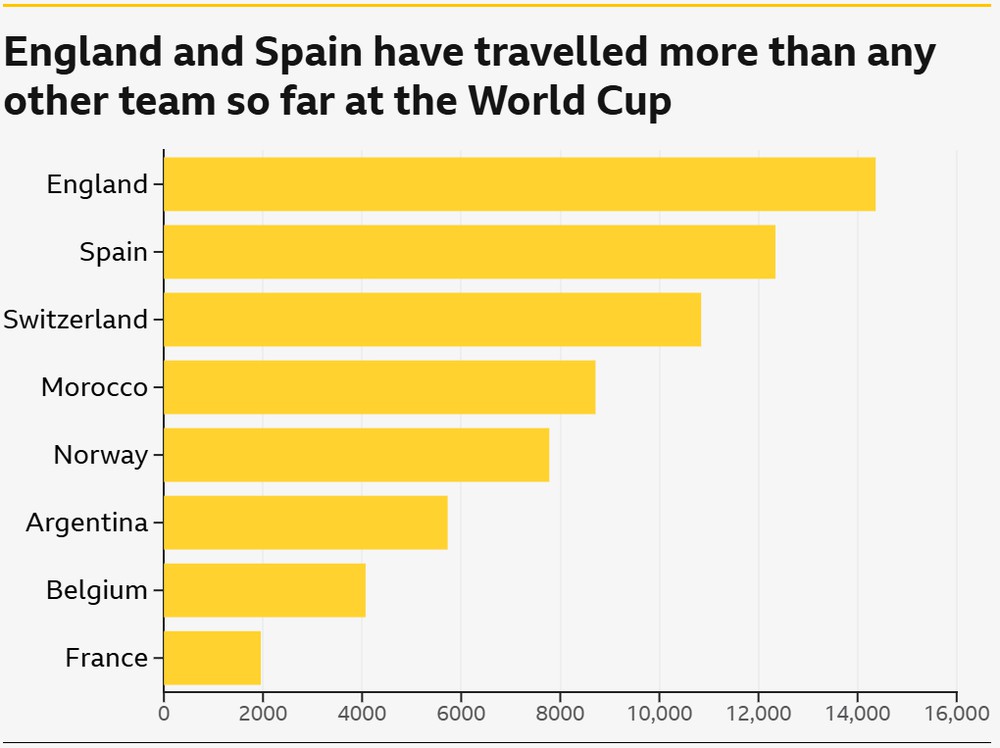
Statistics on travel distances for the eight teams that reached the quarterfinals of the 2026 World Cup
Argentina also set up camp in Kansas City but has only traveled over 8,000 miles, while France has nearly exclusively played in the eastern United States, with a total distance of less than 2,000 miles before heading to Dallas for their semifinal match against Spain. This figure is even less than many teams eliminated after just three group-stage matches. The round trip to Dallas, about 3,000 miles, will more than double France's total travel distance in the tournament.
England is not the only team enduring a packed flight schedule. Spain has accumulated over 12,000 miles, while Switzerland has surpassed 10,000 miles due to a schedule that constantly changes venues across North America—a journey the Swiss Football Federation describes as "hopping between cities."
Long-distance travel is nothing new at World Cups. The tournaments in Brazil in 2014, Russia in 2018, and South Africa in 2010 all required significant movement. However, the first 48-team World Cup has created a completely different challenge. With matches held across three countries and 16 cities, some teams must constantly fly back and forth across North America for weeks, while others operate almost entirely within a single geographic region.
Does extensive travel affect performance?
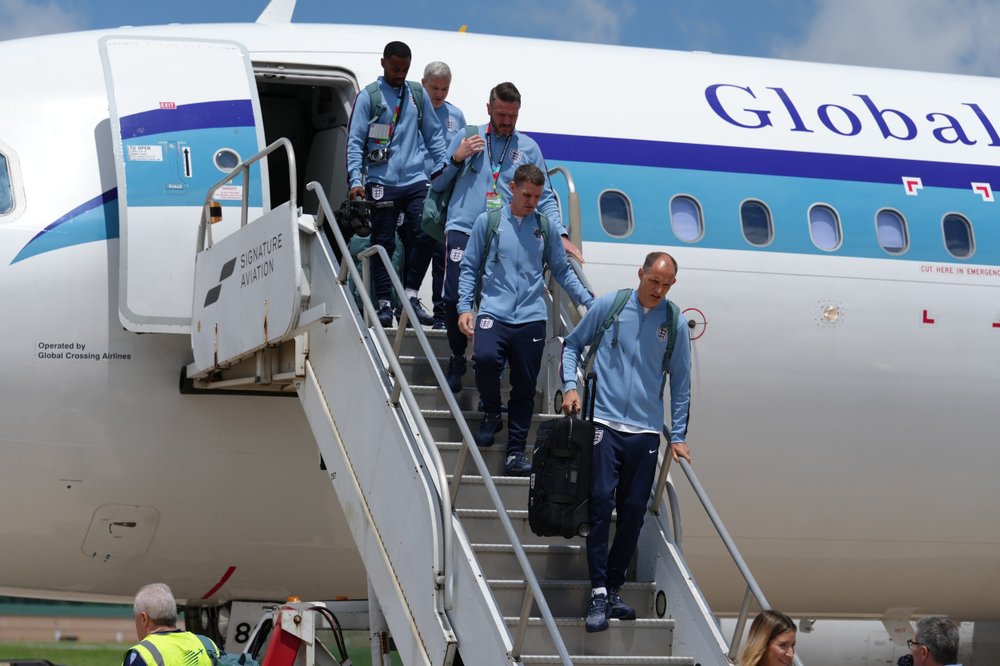
Coach Tuchel and his players have been flying back and forth continuously at this 2026 World Cup. Photo: AFP
It is impossible to determine exactly how much extensive travel affects on-field performance. However, Norway coach Stale Solbakken—whose team reached the quarterfinals—admitted that the tournament's physical demands have begun to take their toll. "We only really had Jorgen (Strand Larsen) with a fever, but aside from that, there have been a few scattered cases of coughs and hoarseness. Air conditioning, flights, changing rooms, and all sorts of things have an impact. There are 50 people in the delegation, so it would be strange if no one had any issues."
Norway's journey was considerably shorter than England's. After setting up camp in Greensboro, North Carolina, during the early stages of the tournament, they stopped returning to their base after each match once the knockout rounds began. In contrast, England persisted in flying back to Kansas City after every game.
Whether those accumulated thousands of miles become a decisive factor in success or failure will never have a precise answer. However, an undeniable fact is that France is nearly the team that traveled the least among the four semifinalists.
View the latest 2026 World Cup news
View the 2026 World Cup schedule
View the 2026 World Cup standings


Wonderfulshortvideo

BARCELONA REVENUE barcelona news today



Lashed home by Kieffer Moore ☄️

The saxophones are getting louder for Preston here…

When football is simple but beautiful 😍

Cristiano Ronaldo is back on the quest for 1,000 goals, and these are his 977th and 978th goals.

messi argentina retirement messi retiring messi edit

The Swans go TOP of the Championship 🦢
 Links
Links
 Contact
 App
App


